english
  deutsch
  français
New on WERGO – To Celebrate the 90th Birthday of Aribert Reimann
- By Charlotte Schmitt
- 2 Mar 2026

Photo: Schott Promotion/Gaby Gerster
In his substantial compositional output, Aribert Reimann created a rich collection of compositions which have unquestionably exerted an influence on contemporary music theatre. His unmistakable personal style is characterised by strict logic and highly complex tonal structures which are finely chiselled down to the smallest detail. At the same time, his music possesses a powerful innate emotionality which directly captures his listeners. This is borne out by his instrumental works and vocal compositions and to a particular degree, his operas, which are considered the most significant of the entire contemporary period. Reimann primarily selects his plots from world literature and transforms them into unique forms through his own musical language.
REIMANN'S MUSICAL SETTING OF AUGUST STRINDBERG'S "A DREAM PLAY"
In 1963, Aribert Reimann composed his first opera, “Ein Traumspiel” (A Dream Play), based on the play by August Strindberg. He first came into contact with the world of the poet as a boy. Reimann told his biographer Wolfgang Burde that he became “completely crazy about Strindberg.” And even though he only read parts of Strindberg’s plays at the time, the seed had been planted for his later, intensive engagement with the works.
DIE HOFER AUFFÜHRUNG
There have been only two other new productions since the original one in Kiel in 1965. Reinhardt Friese, from 2012 until 2024 Intendant of the opera in Hof, was so impressed by a visit to one of these performances that when the opportunity arose, years later, he organized a production of the piece in Hof, directed by Lothar Krause and conducted by Walter E. Gugerbauer, with the first performance taking place on 17 March 2018. The current album recording was made in the course of this production, a live recording.
“After 54 years, I heard my ‘Traumspiel’ just as I had imagined it!”
(Aribert Reimann on the Hof performance)
The production by the Hof Theater that was enthusiastically acclaimed by critics and opera audiences alike.
FROM STRINDBERG TO RILKE
In addition to August Strindberg, Reimann was also inspired by the poetry of Rainer Maria Rilke, although he takes a completely different musical approach to Rilke's first “Duino Elegy”: in his composition “Denn Bleiben ist nirgends” (For to Stay is to be Nowhere), he combines the text, recited by a speaker, with a symphony orchestra playing in a broad, expansive style to create a melodrama.
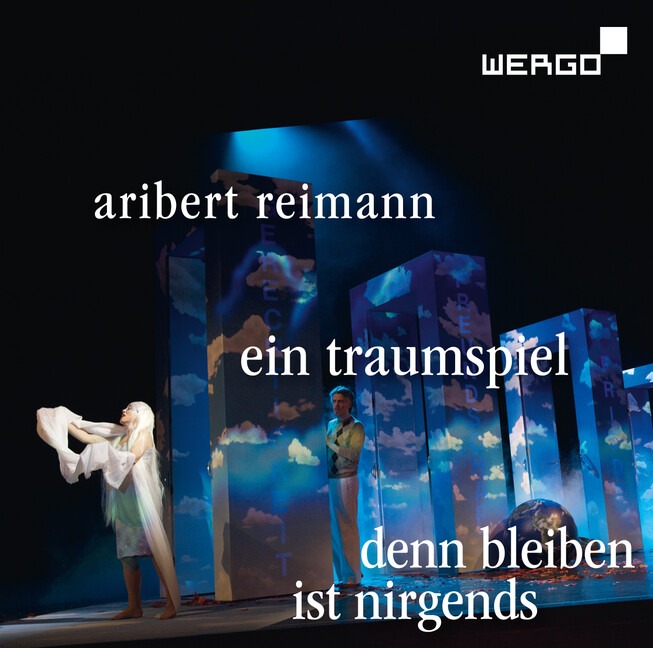 |
Ein Traumspiel | A Dream PlayDenn Bleiben ist nirgends | For to Stay is to be NowhereAribert ReimannEin Traumspiel | A Dream Play after August Strindberg’s play “Ett drömspel”, German translation by Peter Weiss, libretto arranged by Carla Henius Denn Bleiben ist nirgends | For to Stay is to be Nowhere. First Duino Elegy by Rainer Maria Rilke for narrator and orchestra
|