english
  deutsch
  français
NEW ON WERGO – ENNO POPPE: KÖRPER
- By Charlotte Schmitt
- 4 Aug 2025
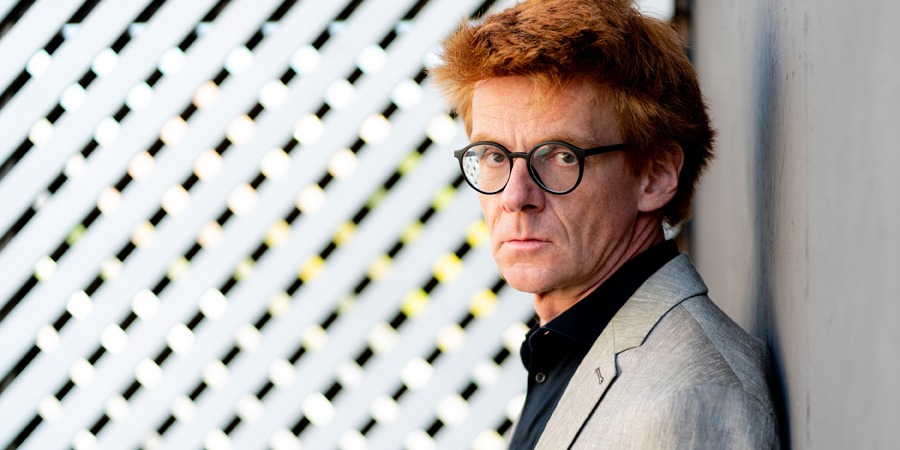
Foto: Ricordi_Harald-Hoffman
The new album Körper [Body] with works by Enno Poppe joins a series of its own on WERGO, the albums of which are dedicated to the composer born in 1969.
One of Germany’s most important composers of New Music
Enno Poppe's works are probably performed more often than those of any other living German composer – not only in Germany. With his idiosyncratic manner of dealing with tradition, this red-haired artist, born in 1969, has developed an instantly recognizable musical style that fascinates and touches both specialists and listeners normally skeptical of new music.
Works for renowned New Music ensembles
The compositions Gold and Körper [Body] employ two very different types of ensembles. Gold for mixed choir a cappella with the SWR Vokalensemble is one of only two choral works that Poppe has composed. And although Poppe has written many works for instrumental ensembles, Körper with the Ensemble Modern was conceived for a very specific constellation: big band. These very different points of departure for the two works influenced the composer’s decisions regarding the types of material and structure he used.
The composer Enno Poppe
Enno Poppe studied conducting and composition at the University of the Arts in Berlin. In addition to a number of scholarships – from the Akademie Schloss Solitude and Villa Serpentara in Olevano Romano, for example – he received the Boris Blacher Prize in 1998, the city of Stuttgart’s Composition Prize in 2000, the Busoni Composition Prize from the Academy of the Arts in Berlin in 2002, the Ernst von Siemens Foundation Composer Prize in 2004, the Schneider Schott Prize in 2005, the Kaske Foundation Prize in 2009, and the Hans and Gertrud Zender Foundation Prize in 2011. He is a member of the Academy of the Arts in Berlin, the Academy of Sciences and Arts in Düsseldorf, and the Bavarian Academy of Fine Arts in Munich. His works have been performed at prominent New Music festivals throughout the world by almost all the important ensembles in the field. Since 1998, he has been a member of ensemble mosaik as a conductor. He lives and works in Berlin.
Liste to Enno Poppe "Körper"
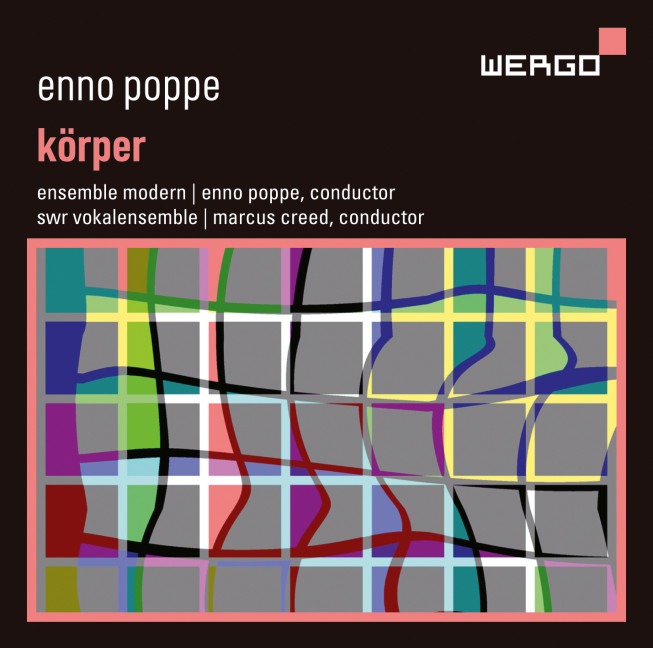 |
KörperEnno PoppeEnno Poppe has ‘tailor-made’ concise ensemble works for two of the most important ensembles of contemporary music: “Gold” – a purely vocal work for the SWR Vokalensemble – and “Körper” – for the Ensemble Modern. In the three-part a cappella work “Gold” (one of only two choral compositions to date), Poppe indulges for the first time in his love of the lustfully excessive texts by Arno Holz (1863–1929), one of the most important representatives of German Naturalism and literary Modernism. The poems are parodistically related to less humorous high literature. The SWR Vokalensemble’s supple miracle sound appears confidently in various combinations, sometimes fanned out in 24 voices as in old vocal polyphony. “Körper” takes us to another end of the scale of possible sounds. Here, the 21 soloists of the Ensemble Modern form a formidable big band, augmented by appropriate woodwind and brass instruments (including saxophones, of course). Here, however, Poppe is more concerned with exploring and expanding what the big band provides as a ‘sound body’, i.e. the colors, dynamic and rhythmic possibilities, with the means of New Music, an art that the Ensemble Modern has truly perfected. As so often with Poppe, the piece “Körper” goes through multiple processes of intensification and collapse. In the climaxes, the physicality of the music is almost overwhelming. Nevertheless, the nuclei of the piece are the intimate, thinly scored moments when the electric strings ever so gradually rise up with the percussion, or when a saxophone, a keyboard, or a trombone steps out of the thicket of sound and is allowed a few moments of self-discovery. Coproduction with Hessischer Rundfunk (1–4), Production of Südwestrundfunks (5-7), Licensed by SWR Media Services GmbH. |