english
  deutsch
  français
Two women, one mission: How German Christmas Carols Took Over the World
- 15 Oct 2025

Catherine Winkworth
On behalf of women's education and German church music in Great Britain
|
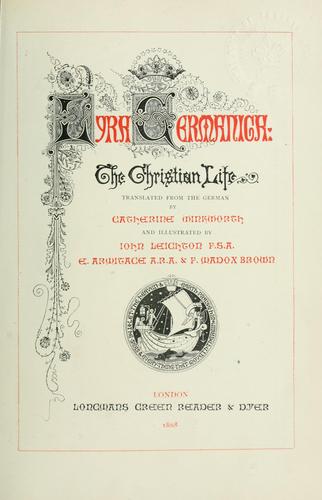
Catherine Winkworth (1827–1878) is considered one of the most important proponents of German church music in Victorian England. Her translations, such as “From Heaven Above” (Vom Himmel hoch, Martin Luther) and “Ah wounded Head! Must Thou” (O Haupt voll Blut und Wunden, Paul Gerhardt), can still be found in many English hymnals today. Winkworth was convinced that the music and theology of German chorales were a valuable enrichment for the English-speaking church’s services and had the courage to back this up with her own translations. Born in London and raised in Manchester, she received a thorough education, both philosophical and religious, as the daughter of a successful merchant. From an early age, Winkworth developed a strong interest in the German language and its literature. During her year abroad in Dresden, however, her attention soon turned to the German church music tradition. She was fascinated by the spiritual depth and power of these songs. Spreading this art form in the English-speaking world became her life's work. In 1854, she published her first collection of selected hymns with singable English translations under the title Lyra Germanica: Hymns for the Sundays and Chief Festivals of the Christian Year. The book was an immediate success, and more were to follow. At a time when women were often marginalised in cultural life, this was quite remarkable. |
 |
But Winkworth was not only a translator. She was also committed to promoting women's education in Great Britain. She was managing director of the Clifton Association for Higher Education for Women and a member of Cheltenham Ladies' College. She was also director of the Red Maids' School in Westbury-on-Trym in Bristol.
Winkworth’s work across translation and education was united by a conviction that education, culture and faith should be accessible to all. She was part of a broader movement of Victorian women who were involved in church music and its dissemination, among other thing, often unnoticed, but nevertheless effective.
Natalia Macfarren
From Lübeck to London – How Natalia Macfarren established German music in England
Natalia Macfarren (1826–1916), born in Lübeck as Clarina Thalia Andrae and soon afterwards migrating to England with her parents, is particularly renowned for her translations of German opera libretti into English. She became famous above all for her translations of Wagner (including Lohengrin and Tannhäuser), which she made accessible to English-speaking audiences for the first time. Macfarren also translated numerous Italian operas, such as Mozart's Don Giovanni and Verdi's La Traviata. Her translations are characterised by a precise linguistic connection to the melody, a quality that benefited from her thorough training as an alto at the Royal Academy of Music.
In addition to opera libretti, she also translated songs (Brahms, Dvořák) and sacred works, especially choral music, into English. Like Catherine Winkworth, she played a key role in establishing German music literature as an integral part of Victorian British culture.
Natalia Macfarren remained musically active into her old age. Her work was appreciated during her lifetime, but, as was the case with many women of that era, never received the recognition it deserved. Today, her contribution to intercultural music education is increasingly being rediscovered and recognised.
A legacy that lives on
These pioneers did more than just translate song lyrics – through their work, they forged connections that endure to this day. In a world marked by tensions, then as now, their translations serve as small messages of peace.
The first volume of the new series VocaTre Merry Christmas for three-part choir (SAB) a cappella picks up on precisely this legacy. It brings together German and English Christmas carols, most of which were translated into the other language by Winkworth, Macfarren and their contemporaries, and invites choirs to build musical bridges between cultures.
Catherine Winkworth and Natalia Macfarren showed us how music can transcend boundaries when performed in the respective national language. Their voices echo in numerous hymnals and in every Christmas carol sung in a foreign language today. With editions such as Merry Christmas, we continue this legacy in concerts and festive church services with a wish that all languages understand: peace on Earth.
More about Merry Christmas
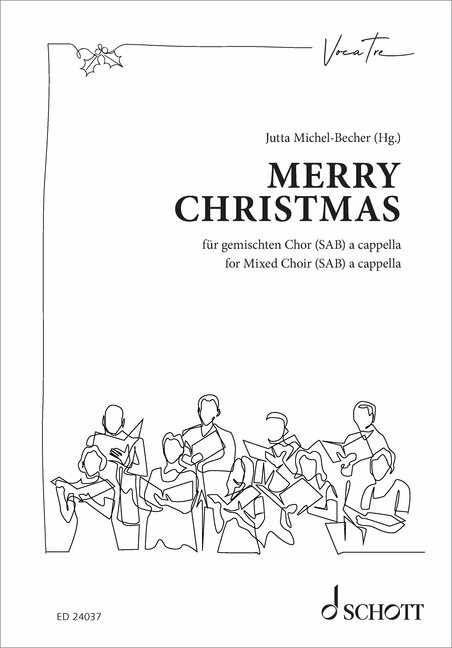 |
Merry ChristmasJutta Michel-Becher (Ed.)Whether for festive Advent concerts, atmospheric Christmas services or simply for singing together during the most wonderful time of the year, this new anthology offers a diverse selection of German and English-language Christmas carols in easy to moderately difficult arrangements for three-part choir (SAB) a cappella. With great attention to detail and an eye for international understanding, the edition contains not only well-known classics, but also rarely heard treasures, with almost all songs printed in both languages (German/English). This makes every concert programme a bridge between cultures. There is a special focus on historical English translations of German Christmas carols from the 19th century, which have been supplemented with new transcriptions.
Give your choir musical diversity and international warmth – with this compact collection of Advent and Christmas choral music!
|