english
  deutsch
  français
Toshio Hosokawa – 70 years of music between Japan and Europe
- By Andreas Krause
- 23 Oct 2025

On the 23th of October 2025, Toshio Hosokawa, one of the world's most frequently performed contemporary composers, celebrates his 70th birthday. It is an occasion to look back at the remarkable work of an artist who combines Japanese tradition with Western avant-garde like no other, and whose music continues to be celebrated on international stages.
Three special events were organised to mark this momentous year: the new production of his opera Matsukaze at the Bavarian State Opera in Munich, the presentation of the prestigious Frontiers of Knowledge Award by the Spanish BBVA Foundation in Bilbao, and the world premiere of his latest opera Natasha at the New National Theatre Tokyo (NNTT). All three events highlight Hosokawa’s continuing influence in in Japan, Europe and far beyond.
Between Noh theatre and modernity: Matsukaze in Munich
One of the highlights of the recent season was Hosokawa's opera Matsukaze, which was performed as part of the Bavarian State Opera’s “Ja, Mai” festival. The festival focused on contemporary opera and featured Hosokawa’s work alongside Das Jagdgewehr by Austrian composer Thomas Larcher, who is also published by Schott.
Both operas are based on stories from traditional Japanese Noh theatre and were performed alternately throughout the week, forming an exciting contrast. Larcher's Das Jagdgewehr was staged in a colourful and expressive manner in the historic Cuvilliés Theatre, whilst Matsukaze appeared in the Old Riding Hall of Munich’s new Utopia Cultural Centre as a sparse, meditative counterpart.
The audience sat on black cushions and could move freely between the objects, orchestra and dancers, creating an immersive experience reminiscent of ritual shamanic performances. This unconventional form of music theatre sparked some debate, but the overall response was one of great enthusiasm.
The Frontiers of Knowledge Award
In June 2025, Toshio Hosokawa was presented with the international “Frontiers of Knowledge Award” in the Music and Opera category in Bilbao. Comparable to the Nobel Prize, the BBVA Foundation prize is regarded by experts as one of the most prestigious cultural honours worldwide.
The jury recognised Hosokawa “for the exceptional reach of his music, which builds a bridge between Japanese tradition and contemporary Western aesthetics.”
The Hungarian composer and fellow Schott composer Peter Eötvös received this award in 2020, placing Hosokawa among a distinguished group of outstanding composers.
His violin concerto Genesis was performed at the gala concert by Japanese violinist Akiko Suwanai. Around a thousand guests celebrated the composer, whose works are increasingly seen to be a bridge between contemplation and modern musical language.
In June, Bilbao was decorated with large posters of the award winners – a visible sign that Hosokawa's music has long since gained global recognition.
Natasha: A new opera by Toshio Hosokawa
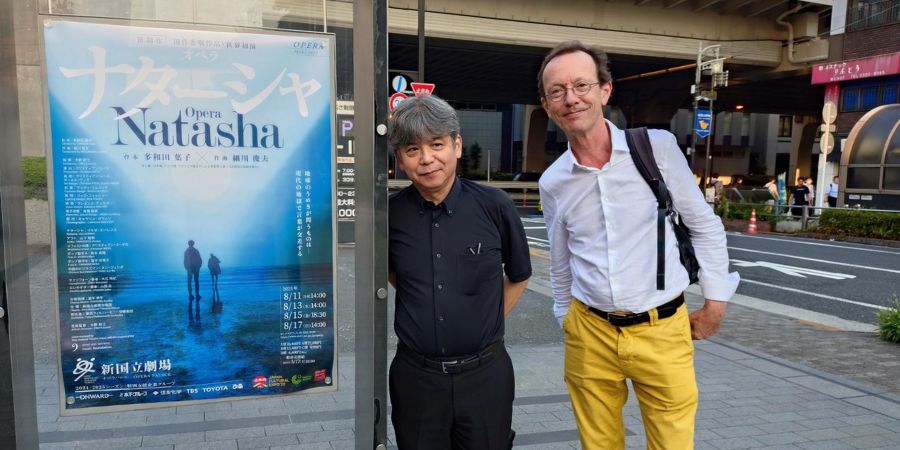
The highlight of the anniversary year was the world premiere of the opera Natasha on the 11th of August 2025 at the New National Theatre Tokyo. The work was created in collaboration with Berlin-based Japanese author Yoko Tawada, who wrote the libretto.
The plot takes the audience through the seven hells of our time – a motif inspired by Goethe's Faust, Dante's Divine Comedy and Mozart's Magic Flute. Young lovers Natasha and Arato encounter Mephisto's grandson, who guides them through fire, war, consumerism and environmental destruction. Yet, in the end, a vision of hope emerges: the idea of a world that can be healed.
Musically, Hosokawa shows greater experimentation than ever before. The opera moves between meditative soundscapes and bursts of rock music featuring electric guitar and saxophone, spanning a broad stylistic spectrum. Natasha’s baroque-style lament in C minor, “Wozu der Mensch?”, is especially moving.
Just as Hosokawa’s music builds a musical bridge between East and West, producing his score brought Schott Mainz and Schott Japan together to integrate Japanese characters into the printed scores – a first for Schott Mainz. The complex proofing process ensured accuracy across offices. The premiere, conducted by Kazushi Ono, was completely sold out and received an enthusiastic reception.
Between nature, silence and time: Hosokawa's musical philosophy
Toshio Hosokawa is one of the most influential figures of contemporary music in Asia. Born in Hiroshima in 1955, he first studied piano and composition in Tokyo before moving to Berlin in 1976 to study with Isang Yun at the Hochschule der Künste. He later continued his studies in Freiburg with Klaus Huber.
His early works were presented and discussed at the International Summer Courses for New Music Darmstadt, where he later returned as a lecturer and became a central figure of the international avant-garde.
Hosokawa's music is deeply rooted in Zen Buddhist philosophy. Sound and silence do not oppose one another but form a single unity, a principle reflected in works such as In die Tiefe der Zeit (1994) and Circulating Ocean (2005). Each note has meaning, each sound arises from silence.
His music blends Western forms, from Bach to Webern, with the aesthetics of traditional Japanese instruments, resulting in a musical language that feels both timeless and deeply contemporary.
Major works and international success
Hosokawa's catalogue of works includes orchestral, chamber and vocal works, operas, oratorios and compositions for traditional Japanese instruments. Many have been premiered by world-renowned conductors, including Kent Nagano, Sir Simon Rattle, Kazushi Ono and Robin Ticciati.
Some key compositions include:
-
Voiceless Voice in Hiroshima (1989/2000) – an oratorio about the atomic bombing of Hosokawa's hometown, moving between pain, remembrance and silence
-
Circulating Ocean (2005) – composed for the Salzburg Festival, this symphonic work depicts the movement of the sea in sound
-
Lotus under the Moonlight (2006) – a piano concerto in homage to Mozart, premiered by the NDR Symphony Orchestra under Seiji Ozawa
-
Horn Concerto – Moment of Blossoming (2011) – written for horn player Stefan Dohr and the Berlin Philharmonic
-
Woven Dreams (2010) – premiered at the Lucerne Festival and awarded the British Composer Award in 2013
-
Stilles Meer (2016) – an opera that reflects on the Fukushima disaster, a haunting meditation on loss and hope
Hosokawa's operas between East and West
Hosokawa made his debut as an opera composer with Visions of Lear (1998), a Shakespeare adaptation that fused European musical theatre with elements of Noh. He developed this concept in Hanjo (2004), premiered at the Festival d’Aix-en-Provence, and Matsukaze (2011) at La Monnaie in Brussels, directed by Sasha Waltz. These works firmly established Hosokawa as one of the leading opera composers of the 21st century.
With Natasha, Hosokawa returns to the mythical and spiritual themes that have inspired much of his work, now presented in a global, multilingual form that speaks directly to the present day.
International recognition and awards
Hosokawa has received numerous international prizes, including the Irino Prize (1982), Arion Music Prize (1984), Kyoto Music Prize (1988), Rheingau Music Prize (1998), Duisburg Music Prize (1998), and the Japan Prize of the University of California, Berkeley (2023).
From 1998 to 2007, he was Composer in Residence with the Tokyo Symphony Orchestra and a member of the Academy of Arts, Berlin. He has appeared at leading festivals including the Venice Biennale, Lucerne Festival, and musica viva Munich.
As Artistic Director of the Takefu International Music Festival, he continues to shape Japan’s contemporary music scene. Since 2004, he has been Visiting Professor at the Tokyo College of Music.
Hosokawa resides in both Nagano, Japan, and Mainz, Germany, mirroring the East–West dialogue central to his work.
Between Tokyo and Mainz: Thoughts on the anniversary year
My stay in Tokyo in August 2025 provided an opportunity to meet Hosokawa in person and attend a performance of Natasha. Alongside rehearsals and meetings with colleagues from Schott Japan, Yuki Yukota and Yuki Shindo, I attended performances by the Hiroshima Symphony Orchestra under Christian Arming with soloist Daniil Trifonov, as well as a concert by young composer Noriko Koide at the Muza Kawasaki Symphony Hall.
The trip concluded with an inspiring meeting with Atsuhiko Gondai and Masato Suzuki, co-director of the renowned Bach Collegium Japan.
A new opera collaboration for 2026 is already being planned.
Between East and West: Why Toshio Hosokawa is so important today
Toshio Hosokawa's 70th birthday is more than just a personal milestone. It serves as a reminder of the importance of cultural bridges in music.
While international attention increasingly focuses on the Chinese music market, German-Japanese musical relations remain invaluable, strengthened by the collaboration between Schott Music and Schott Japan, founded in the 1970s by Peter Hanser-Strecker.
Hosokawa’s work demonstrates how deeply rooted cultural traditions can be brought into a modern context without losing their spiritual essence. His music opens spaces of stillness in a noisy world and connects listeners across continents.
On his 70th birthday, the musical world celebrates Hosokawa as a composer who unites Western avant-garde with Eastern philosophy. His music is meditative yet dramatically powerful.
Whether in Matsukaze, Stilles Meer, or Natasha, Hosokawa creates soundscapes that transcend the boundaries of language, space and time. And perhaps this is precisely the secret of his enduring fascination: music that arises from and returns to silence.