 français
  deutsch
  english

Richard Wagner
Pays d'origine:
Allemagne
Date d'anniversaire:
22 mai 1813
Date de décès:
13 février 1883
À venir
Rienzi, der Letzte der Tribunen
Chef d'orchestre: Nathalie Stutzmann
Orchestre: Orchester der Bayreuther Festspiele
17 août 2026 |
Bayreuth (Allemagne) , Festspielhaus
Rienzi, der Letzte der Tribunen
Chef d'orchestre: Nathalie Stutzmann
Orchestre: Orchester der Bayreuther Festspiele
19 août 2026 |
Bayreuth (Allemagne) , Festspielhaus
À propos de Richard Wagner
The childhood of Richard Wagner (born on 22 May 1813) was divided between Dresden and Leipzig, where he had his first composition lessons in 1831/32 from Christian Theodor Weinlig, cantor at the Thomasschule. In 1833 he became chorus master at the Würzburg theatre. Later he held brief appointments as music director at theatres in Bad Lauchstädt, Magdeburg, and Königsberg, where he married the actress Minna Planer in 1836.
A conducting engagement took him to Riga in 1837, but in 1839 Wagner and Minna left Riga and his creditors under cover of night, heading for Paris over the stormy Baltic Sea. There he remained for three hard years, completing Rienzi (1840). His years in Paris turned into a bitterly disappointing experience. He eked out something less than a living by doing musical hack-work and writing articles. His first success with Rienzi in Dresden in 1842 led to his appointment as musical director (Hofkapellmeister) at Dresden in 1843, and shortly afterwards Der fliegende Holländer as well as his innovative Tannhäuser were performed for the first time. Some of his outstanding achievements were a performance of Beethoven’s Ninth Symphony and his revised version of Gluck’s Iphigenie in Aulis.
In May 1849, having taken part in the revolt in Saxony, Wagner had to flee abroad, and after failing to establish himself as opera composer in Paris he settled with his wife in Zurich in 1857. They lived in a house on the Wesendonck estate under the patronage of the financier Otto von Wesendonck. While in Zurich he published various theoretical writings and composed Das Rheingold, Die Walküre and two acts of the opera Siegfried. While working on the Ring cycle, Wagner had fallen in love with Mathilde Wesendonck, the wife of his wealthy patron. The Ring Cycle work was interrupted in 1857 and not continued until 12 years later. He shifted his interest to a new subject, the love tragedy Tristan und Isolde. In an untenable situation in 1858 he moved first to Venice, then to Lucerne, Paris and Vienna.
Although he was composing what would become some of the most famous pieces in music history, Wagner struggled financially until 1864, when Ludwig II of Bavaria called him to Munich and began supporting him. So, in 1865 Tristan und Isolde and in 1868 Die Meistersinger von Nürnberg were premiered in Munich. Already by 1866 Wagner had fallen into disfavour amongst members of the court, who were suspicious of his influence on the king. He left Munich and went to Tribschen (near Lucerne), where he married Cosima von Bülow in 1870, the daughter of his friend Franz Liszt, who always supported him humanly and artistically. Around that time Die Meistersinger was finished, and he worked steadily at the unfinished portion of Der Ring des Nibelungen and further evolved the intellectual framework for his towering mature masterpieces.
In 1872 Wagner, his wife and the three children Isolde, Eva and Siegfried settled in Bayreuth. Wagner was anxious to have a special Festival Theatre for the complete cycle and spent much energy trying to raise money for it. Finally, King Ludwig II provided the necessary support. In 1872 the cornerstone was laid on Bayreuth’s Green Hill and the opera house was built to his personal specifications and suited to the massive fusion of music, staging, text, and scene design that his later operas entailed. The first festival – an artistic triumph but a financial disaster – was held there in 1876, when the complete Ring was given conducted by Hans Richter. In 1882 the second Bayreuth Festival took place with sixteen performances of Parsifal under Hermann Levi, which were financially successful. After that, Wagner and his family who had already spent the winter in Italy for some years, went to Venice where he died on 13 February 1883 of the heart trouble that had been with him for some years.
Produits
-
 Arie für Bass, Männerchor und Orchester für die Oper „Norma“ von Vincenzo BelliniCompositeur: Richard WagnerEditeur: Egon VossMedia Type: Matériel en location / d'exécutionEdition: Matériel d'exécutionLangue: ItalienMatériel en location / d'exécutionMatériel en location / d'exécution
 -
 The Flying Dutchman (Overture) / The Mastersingers (Prelude)Compositeur: Richard WagnerEditeur: Egon VossMedia Type: Partition avec CDEdition: Partition d'étudeSérie: Eulenburg Audio+Score
Instrumentation: orchestreLangue: Allemand, AnglaisNuméro du produit: EAS 148Format papier + CDFormat papier + CDEn stock17,00 €TTC, hors expédition -
 Tristan und Isolde - Lohengrin - TannhäuserCompositeur: Richard WagnerEditeur: John Deathridge | Klaus Döge | Reinhard Strohm | Isolde Vetter | Egon VossMedia Type: Partition avec CDEdition: Partition d'étudeSérie: Eulenburg Audio+Score
Instrumentation: orchestreLangue: Allemand, AnglaisNuméro du produit: EAS 180Format papier + CDFormat papier + CDEn stock15,50 €TTC, hors expédition -
Compositeur: Richard WagnerEditeur: Ernst PraetoriusMedia Type: PartitionEdition: Partition d'étudeInstrumentation: orchestreNuméro du produit: ETP 671Format papierFormat papierÉpuisé10,00 €TTC, hors expédition
-
 Fromental Halévy: "La Reine de Chypre"Compositeur: Richard WagnerEditeur: Egon VossMedia Type: PartitionEdition: Partition et notes critiques, complete editionSérie: Richard Wagner - Complete Works, Vol. 20/II C
Numéro du produit: RWA 120-22Format papierFormat papierEn stock405,00 €TTC, hors expédition -
Sonate in As-Dur für Klavier (WWV 85)Compositeur: Richard WagnerMedia Type: Matériel en location / d'exécutionEdition: Matériel d'exécutionInstrumentation: orchestreMatériel en location / d'exécutionMatériel en location / d'exécution
-
für Violine und Orchester eingerichtet von Edmund SingerCompositeur: Richard WagnerMedia Type: Matériel en location / d'exécutionEdition: Matériel d'exécutionMatériel en location / d'exécutionMatériel en location / d'exécution
-
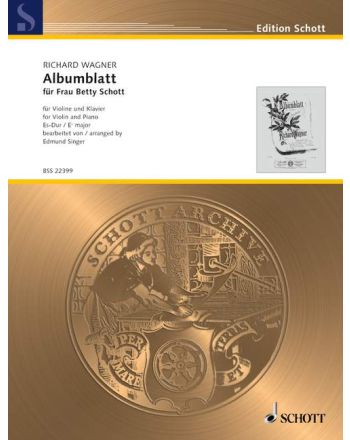 für Frau Betty SchottCompositeur: Richard WagnerArrangeur: Edmund SingerSérie: Schott Archive
Instrumentation: violon et pianoNuméro du produit: BSS 22399Type de produitEn stockPrix à partir de 6,99 €TTC -
Compositeur: Richard WagnerMedia Type: Partition électronique en PDFInstrumentation: pianoNuméro du produit: BSS 22134 Q20548Partition PDFPartition PDFEn stock4,99 €TTC
-
 (Tannhäuser und der Sängerkrieg auf Wartburg)Compositeur: Richard WagnerMedia Type: Partition électronique en PDFInstrumentation: soprano and pianoNuméro du produit: ED 22889 Q815922Partition PDFPartition PDFEn stock3,99 €TTC
 -
Gebet der Elisabeth aus "Tannhäuser"Compositeur: Richard WagnerEditeur: Johannes DöbberMedia Type: PartitionSérie: Operngesänge, 263
Instrumentation: soprano et pianoLangue: AllemandNuméro du produit: RL35580Format papierFormat papierEn stock7,00 €TTC, hors expédition -
Gebet des Rienzi aus "Rienzi"Compositeur: Richard WagnerMedia Type: PartitionSérie: Operngesänge, 252
Instrumentation: ténor et pianoLangue: AllemandNuméro du produit: RL35590Format papierFormat papierEn stock7,00 €TTC, hors expédition -
 Gebet der Elisabeth aus der Oper "Tannhäuser"Compositeur: Richard WagnerArrangeur: Karl KlindworthInstrumentation: soprano et pianoNuméro du produit: ED0 2825Type de produitEn stockPrix à partir de 3,99 €TTC
 -
 Am 15. Dezember 1844Compositeur: Richard WagnerEdition: Partition de choeurSérie: Schott Choral Music
Instrumentation: choeur d'hommes (TTBB) a cappellaNuméro du produit: C 55506Type de produitEn stockPrix à partir de 2,99 €TTC -
aus "Die Meistersinger von Nürnberg"Compositeur: Richard WagnerArrangeur: Heinrich PoosEdition: PartitionInstrumentation: choeur mixte (SATB) avec piano à 4 mainsNuméro du produit: ED 7157Type de produitEn stockPrix à partir de 17,99 €TTC
-
aus "Die Meistersinger von Nürnberg"Compositeur: Richard WagnerEditeur: Cyrill KistlerEdition: Partie séparée, KontrabassSérie: Schott Choral Music
Instrumentation: choeur mixte (SATB) ou choeur d'hommes (TTBB/TB) et orchestreNuméro du produit: C 24061-16Type de produitEn stockPrix à partir de 3,99 €TTC -
aus "Die Meistersinger von Nürnberg"Compositeur: Richard WagnerEditeur: Cyrill KistlerEdition: PartitionSérie: Schott Choral Music
Instrumentation: choeur mixte (SATB) ou choeur d'hommes (TTBB/TB) et orchestreNuméro du produit: C 24061Type de produitEn stockPrix à partir de 12,99 €TTC -
aus "Die Meistersinger von Nürnberg"Compositeur: Richard WagnerEditeur: Cyrill KistlerMedia Type: Partition électronique en PDFEdition: Jeu de parties d'harmonieSérie: Schott Choral Music
Instrumentation: choeur mixte (SATB) ou choeur d'hommes (TTBB/TB) et orchestreLangue: AllemandNuméro du produit: C 24061-11 Q38470Partition PDFPartition PDFEn stock31,99 €TTC -
aus "Die Meistersinger von Nürnberg"Compositeur: Richard WagnerEditeur: Cyrill KistlerMedia Type: Partition électronique en PDFEdition: Partie séparée, Violine ISérie: Schott Choral Music
Instrumentation: choeur mixte (SATB) ou choeur d'hommes (TTBB/TB) et orchestreLangue: AllemandNuméro du produit: C 24061-12 Q38469Partition PDFPartition PDFEn stock3,99 €TTC -
aus "Die Meistersinger von Nürnberg"Compositeur: Richard WagnerEditeur: Cyrill KistlerMedia Type: Partition électronique en PDFEdition: Partie séparée, Violine IISérie: Schott Choral Music
Instrumentation: choeur mixte (SATB) ou choeur d'hommes (TTBB/TB) et orchestreLangue: AllemandNuméro du produit: C 24061-13 Q38468Partition PDFPartition PDFEn stock3,99 €TTC -
aus "Die Meistersinger von Nürnberg"Compositeur: Richard WagnerEditeur: Cyrill KistlerMedia Type: Partition électronique en PDFEdition: Partie séparée, ViolaSérie: Schott Choral Music
Instrumentation: choeur mixte (SATB) ou choeur d'hommes (TTBB/TB) et orchestreLangue: AllemandNuméro du produit: C 24061-14 Q38467Partition PDFPartition PDFEn stock3,99 €TTC -
aus "Die Meistersinger von Nürnberg"Compositeur: Richard WagnerEditeur: Cyrill KistlerMedia Type: Partition électronique en PDFEdition: Partie séparée, VioloncelloSérie: Schott Choral Music
Instrumentation: choeur mixte (SATB) ou choeur d'hommes (TTBB/TB) et orchestreLangue: AllemandNuméro du produit: C 24061-15 Q38466Partition PDFPartition PDFEn stock3,99 €TTC -
aus "Die Meistersinger von Nürnberg"Compositeur: Richard WagnerEditeur: Cyrill KistlerMedia Type: Partition électronique en PDFEdition: Réduction pour pianoSérie: Schott Choral Music
Instrumentation: choeur d'hommes (TTBB/TB) et orchestreLangue: AllemandNuméro du produit: C 26545 Q38292Partition PDFPartition PDFEn stock3,99 €TTC -
aus "Die Meistersinger von Nürnberg"Compositeur: Richard WagnerEditeur: Cyrill KistlerMedia Type: PartitionEdition: Réduction pour piano, (= Chorpartitur)Série: Schott Choral Music
Instrumentation: choeur mixte (SATB) et orchestreLangue: AllemandNuméro du produit: C 24061-10Format papierFormat papierEn stock6,50 €TTC, hors expédition -
aus der Oper „Tannhäuser”Compositeur: Richard WagnerMedia Type: PartitionInstrumentation: voix alto et pianoLangue: AllemandNuméro du produit: AF 6161Format papierFormat papierEn stock10,95 €TTC, hors expédition
-
 für Sopran und KlavierCompositeur: Richard WagnerEditeur: Petra LangEdition: Partition d'exécutionNuméro du produit: ED 22889Type de produitEn stockPrix à partir de 19,99 €TTC
 -
 für Sopran und KlavierCompositeur: Richard WagnerEditeur: Petra LangEdition: Partition d'exécutionInstrumentation: Sopran und KlavierNuméro du produit: ED 22889 GP17267En stockÀ partir de 3,99 €
 -
 with a documentation on Wagner's German translation of the libretto and his further analysis of the workCompositeur: Richard WagnerEditeur: Christa JostMedia Type: PartitionEdition: Partition et notes critiques, complete editionSéries: Richard Wagner - Complete Works, Vol. 20/IV
Bearbeitung von Glucks "Iphigenia in Aulis"/Konzertschluss zur Ouvertüre, Vol. 20/IV
Numéro du produit: RWA 120-40Format papierFormat papierEn stock425,00 €TTC, hors expédition -
 Klavierauszug zu "Tannhäuser"Compositeur: Richard WagnerEditeur: Egon VossMedia Type: PartitionEdition: Partition et notes critiques, complete editionSérie: Richard Wagner - Complete Works, Vol. 20/III
Numéro du produit: RWA 120-30Format papierFormat papierEn stock296,00 €TTC, hors expédition -
 Klavierauszug von L.v. Beethovens Symphonie Nr. 9 d-Moll op. 125 zu zwei HändenCompositeur: Richard WagnerEditeur: Christa JostMedia Type: PartitionEdition: Partition et notes critiques, complete editionSérie: Richard Wagner - Complete Works, Vol. 20/1
Numéro du produit: RWA 120-10Format papierFormat papierEn stock118,00 €TTC, hors expédition -
 Compositeur: Richard WagnerEditeur: Egon VossMedia Type: PartitionEdition: Partition et notes critiquesSérie: Richard Wagner - Complete Works, Vol. 20/II A
Numéro du produit: RWA 120-20Format papierFormat papierEn stock203,00 €TTC, hors expédition -
 Compositeur: Richard WagnerEditeur: Egon VossMedia Type: PartitionEdition: Partition et notes critiques, complete editionSérie: Richard Wagner - Complete Works, Vol. 20/II B
Numéro du produit: RWA 120-21Format papierFormat papierEn stock290,50 €TTC, hors expédition -
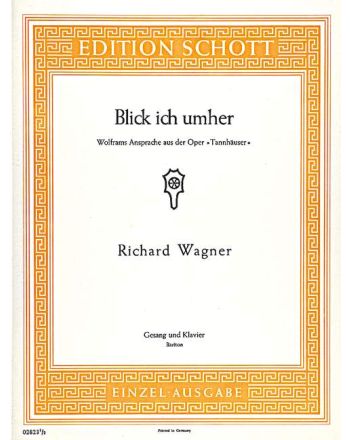 aus "Tannhäuser"Compositeur: Richard WagnerArrangeur: Karl Klindworth | Wilhelm LutzInstrumentation: baryton et pianoNuméro du produit: ED0 2823Type de produitEn stockPrix à partir de 3,99 €TTC
 -
"Treulich geführt ziehet dahin"Compositeur: Richard WagnerArrangeur: Heinrich PoosEdition: Partition de choeurInstrumentation: choeur mixte (SATB) et choeur de femmes (SMezA) avec piano à 4 mainsNuméro du produit: ED 7154-01Type de produitEn stockPrix à partir de 2,99 €TTC
-
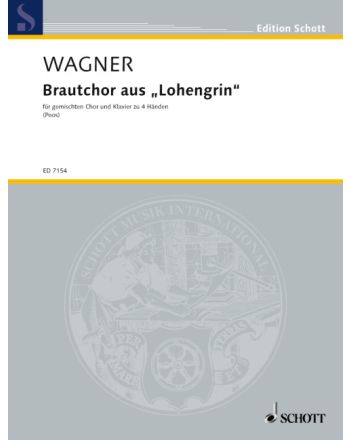 "Treulich geführt ziehet dahin"Compositeur: Richard WagnerArrangeur: Heinrich PoosEdition: Partition, (= Klavierstimme)Série: Edition Schott
Instrumentation: choeur mixte (SSAATB) avec piano à 4 mainsNuméro du produit: ED 7154Type de produitEn stockPrix à partir de 11,99 €TTC -
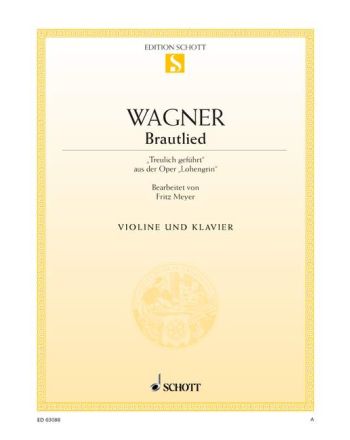 "Treulich geführt" from the opera "Lohengrin"Compositeur: Richard WagnerArrangeur: Fritz MeyerInstrumentation: violon et pianoNuméro du produit: ED0 3088Type de produitEn stockPrix à partir de 3,99 €TTC
 -
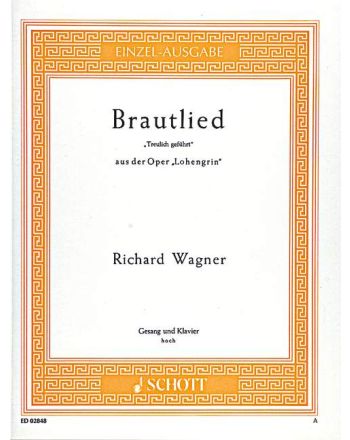 Treulich geführt from "Lohengrin"Compositeur: Richard WagnerArrangeur: Karl Klindworth | Wilhelm LutzInstrumentation: voix aigüe et pianoNuméro du produit: ED0 2848Type de produitEn stockPrix à partir de 3,99 €TTC
 -
 from: LohengrinCompositeur: Richard WagnerArrangeur: Hans-Günter HeumannMedia Type: Partition électronique en PDFNuméro du produit: ED 21129 Q47410Partition PDFPartition PDFEn stock2,99 €TTC
 -
 (from "Lohengrin")Media Type: Partition électronique en PDFNuméro du produit: ED 21698 Q23127Partition PDFPartition PDFEn stock2,99 €TTC
 -
 from the opera "Lohengrin"Compositeur: Richard WagnerArrangeur: Hans-Günter HeumannMedia Type: Partition électronique en PDFInstrumentation: pianoLangue: Allemand, AnglaisNuméro du produit: ED 20850 Q16733Partition PDFPartition PDFEn stock2,99 €TTC
 -
 "Treulich geführt" from the opera "Lohengrin"Compositeur: Richard WagnerArrangeur: L. RitterMedia Type: Partition électronique en PDFInstrumentation: harmonium (avec Text)Numéro du produit: ED0 3024 Q15484Partition PDFPartition PDFEn stock3,99 €TTC
 -
 from the opera "Lohengrin"Compositeur: Richard WagnerArrangeur: Richard KleinmichelInstrumentation: piano (avec texte)Numéro du produit: ED0 2843Type de produitEn stockPrix à partir de 3,99 €TTC
 -
 Die Postkarten-Sammlung zum 100. TodestagMedia Type: DiversEdition: Postcards (10 Pieces)Numéro du produit: SKK 10DiversDiversEn stock3,50 €TTC, hors expédition
 -
aus der Oper „Tannhäuser”Compositeur: Richard WagnerMedia Type: PartitionInstrumentation: voix aigüe et pianoNuméro du produit: AF 6160Format papierFormat papierEn stock7,95 €TTC, hors expédition
-
 from the opera "The Master-Singers of Nuremberg"Compositeur: Richard WagnerArrangeur: August WilhelmjInstrumentation: violon (alto) et pianoNuméro du produit: ED0 4379Type de produitEn stockPrix à partir de 5,99 €TTC
 -
 "Morgenlich leuchtend in rosigem Schein"Compositeur: Richard WagnerArrangeur: Alfred MoffatInstrumentation: 2 violons (violoncelle ad lib.) et pianoNuméro du produit: ED0 8704Type de produitEn stockPrix à partir de 5,99 €TTC
 -
 de l'Opéra"Les Maîtres Chanteurs de Nurenberg"Compositeur: Richard WagnerArrangeur: George GoltermannSérie: Schott Archive
Instrumentation: violoncelle (violon) et pianoNuméro du produit: BSS 19755Type de produitEn stockPrix à partir de 6,99 €TTC -
 de l'opéra "Tannhäuser" transcrit pour orgue par Franz LisztType de produitEn stockPrix à partir de 8,99 €TTC
 -
 extrait de l'opéra "Tannhäuser"Compositeur: Richard WagnerArrangeur: Gustav LangeSérie: Edition Schott
Instrumentation: pianoNuméro du produit: SF 6508Type de produitEn stockPrix à partir de 6,99 €TTC -
"Beglückt darf nun dich, o Heimat, ich schauen" aus "Tannhäuser"Compositeur: Richard WagnerArrangeur: Heinrich PoosEdition: Partition de choeurInstrumentation: choeur d'hommes (TTBB) et orchestre ou piano à 4 mainsNuméro du produit: ED 7155-01Type de produitEn stockPrix à partir de 2,99 €TTC


représentations
Rienzi, der Letzte der Tribunen
Chef d'orchestre: Nathalie Stutzmann
Orchestre: Orchester der Bayreuther Festspiele
17 août 2026 |
Bayreuth (Allemagne) , Festspielhaus
Rienzi, der Letzte der Tribunen
Chef d'orchestre: Nathalie Stutzmann
Orchestre: Orchester der Bayreuther Festspiele
19 août 2026 |
Bayreuth (Allemagne) , Festspielhaus
Götterdämmerung
Chef d'orchestre: Josep Caballé
Orchestre: Moritzburg Festival Orchester
21 août 2026 |
Bad Elster (Allemagne) , König Albert Theater
Rienzi, der Letzte der Tribunen
Chef d'orchestre: Nathalie Stutzmann
Orchestre: Orchester der Bayreuther Festspiele
22 août 2026 |
Bayreuth (Allemagne) , Festspielhaus
Götterdämmerung
Chef d'orchestre: Josep Caballé
Orchestre: Moritzburg Festival Orchester
22 août 2026 |
Dresden (Allemagne) , Kulturpalast
Rienzi, der Letzte der Tribunen
Chef d'orchestre: Nathalie Stutzmann
Orchestre: Orchester der Bayreuther Festspiele
24 août 2026 |
Bayreuth (Allemagne) , Festspielhaus
Rienzi, der Letzte der Tribunen
Chef d'orchestre: Nathalie Stutzmann
Orchestre: Orchester der Bayreuther Festspiele
26 août 2026 |
Bayreuth (Allemagne) , Festspielhaus
The Ring without Words
Chef d'orchestre: Chen Lin
Orchestre: Chengdu Symphony Orchestra
5 septembre 2026 |
Shanghai (Chine) , Symphony Hall
Goetterdaemmerung
Chef d'orchestre: Kent Nagano
Orchestre: Dresdner Festspielorcherster; Concerto Köln
10 septembre 2026 |
Luzern (Suisse) , Kultur- und Kongresszentrum
Die Meistersinger von Nürnberg
Chef d'orchestre: Frank Beermann
Orchestre: Nordwestdeutsche Philharmonie
11 septembre 2026 |
Minden (Allemagne) , Stadttheater — Première soirée
Goetterdaemmerung
Chef d'orchestre: Kent Nagano
Orchestre: Dresdner Festspielorcherster; Concerto Köln
13 septembre 2026 |
Paris (France) , Théâtre des Champs-Élysées
Die Meistersinger von Nürnberg
Chef d'orchestre: Frank Beermann
Orchestre: Nordwestdeutsche Philharmonie
13 septembre 2026 |
Minden (Allemagne) , Stadttheater
Tristan und Isolde
Chef d'orchestre: Alexander Liebreich
Orchestre: Taipei Symphony Orchestra
16 septembre 2026 |
Taipei (Taïwan) , Performing Arts Center, Grand Theatre — Première soirée
Die Walküre
Chef d'orchestre: Antonino Fogliani
Orchestre: Bayerisches Staatsorchester
16 septembre 2026 |
München (Allemagne) , BMW Park
Siegfried
Chef d'orchestre: Pietari Inkinen
Orchestre: DR Symfoniorkestret
17 septembre 2026 |
København (Danemark) , DR Koncerthuset
Goetterdaemmerung
Chef d'orchestre: Pietari Inkinen
Orchestre: DR Symfoniorkestret
17 septembre 2026 |
København (Danemark) , DR Koncerthuset
Performance of excerpts.
Die Meistersinger von Nürnberg (WWV 96)
Chef d'orchestre: Ulf Schirmer
Orchestre: Rundfunk-Sinfonieorchester Berlin
17 septembre 2026 |
Berlin (Allemagne) , Konzerthaus
Die Meistersinger von Nürnberg
Chef d'orchestre: Frank Beermann
Orchestre: Nordwestdeutsche Philharmonie
18 septembre 2026 |
Minden (Allemagne) , Stadttheater
Siegfried
Chef d'orchestre: Pietari Inkinen
Orchestre: DR Symfoniorkestret
18 septembre 2026 |
København (Danemark) , DR Koncerthuset
Goetterdaemmerung
Chef d'orchestre: Pietari Inkinen
Orchestre: DR Symfoniorkestret
18 septembre 2026 |
København (Danemark) , DR Koncerthuset
Performance of excerpts.