english
  deutsch
  français
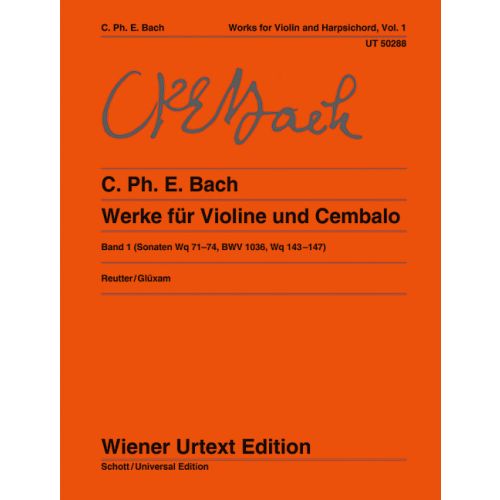
Works for violin and harpsichord
Product Details
Description
Carl Philipp Emanuel Bach's works for violin and harpsichord obbligato pervade his entire compositional oeuvre. The earliest works, like the Sonata in D minor still numbered BWV 1036, date back to the years of study with his father, yet show already a remarkable creative will of his own. The latest work, the fantasia 'C. P. E. Bachs Empfindungen' in F flat minor of 1787 is characterized by the composer's highly expressive late style. The new two-volume edition of Wiener Urtext Edition contains C. P. E. Bach's complete works for harpsichord (piano) obbligato and violin. Vol. 1 contains not only the sonatas Wq 71–74 and BWV 1036 but also the arrangements of the trios Wq 143–145 for violin and harpsichord, most of which are included in C. P. E. Bach's autographs, as well as a – previously ignored – early version of Wq 71 which, like BWV 1036, grants a rare insight into the early works of the composer. Vol. 2 contains the four major sonatas of 1763 which already fascinated Johannes Brahms. Brahms not only played them in concert, together with Joseph Hellmesberger, but also published two of these sonatas in 1864. This volume concludes with the two late works 'Arioso' and 'Fantasie' of 1781 and 1787 respectively. With these works, C. P. E. Bach bridged the gap between the late Baroque sonatas of his father and the early classical 'Klaviersonate mit begleitender Violine' [Piano Sonata with Accompanying Violin].
Content
Notes on interpretation
Ornaments and Cadenzas
Facsimilia
Sonate in D Wq 71
Sonate in d Wq 72
Sonae in C Wq 73
Sonate in D Wq 74
Sonate in D BWV 1036
Sonate in D Wq 145
Sonate in h Wq 143
Sonate in G Wq 144
Sonate in A Wq 146
Sonate in C Wq 147
Critical Notes
More Information
Technical Details
More from this series
Standard works of music literature in the original text
The Wiener Urtext Edition is a scientific critical edition for prac-tice and differs from other editions declared as "original text" in that it contains extensive textual informa-tion in German and English (partly French):
Its preface informs about the work, its genesis and significance for the history of music, about written records and problems of the wording of the text as well as about the respective method applied for editing. Despite their necessary briefness, the critical annotations clearly account for editorial decisions and mention textual divergence going back to the author himself. The music text itself was produced on the basis of an exact checking of all sources by experienced musico-logists. Autographs, first editions, copies and patterns for engravings were used.
In some cases, these materials were analysed completely for the first time. Editions for teaching, studies, concert practice, including comprehensive information about the works by detailed introductions and editorial notes and notes on interpretation. Prepared for practice by interpreters resp. educationalists of international repute.