english
  deutsch
  français
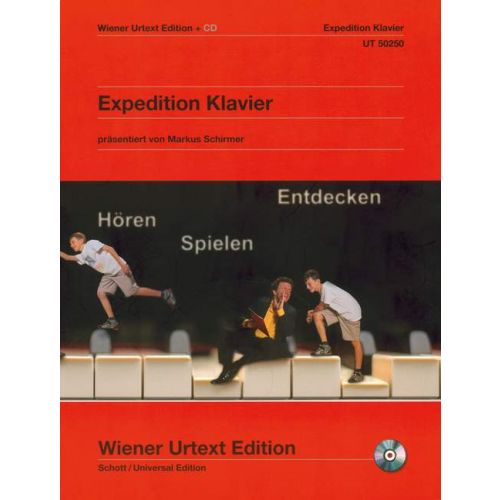
Piano Expedition
Product Details
Description
An interview with the piano teacher Maria Zgubic from Graz at the end of the CD explains to parents and teachers the purpose and meaningfulness of 'Expedition Klavier'.
Content
Praeludium (BWV 924)
Praeludium (BWV 927)
Inventio 1 (BWV 772)
Gavotte (aus "Französische Suite Nr. 5 BWV 816)
C. Petzold: Prélude (aus "Suite de clavecin")
Bourrée (aus "Suite de clavecin
Menuet alternativement (aus "Suite de clavecin")
Menuet 2 (aus "Suite de clavecin")
G.F. Händel: Sarabande (aus Suite HWV 437)
J. Haydn: Sonata 1 (Hob.XVI: 8)
W.A. Mozart: 2 Menuette (KV 1e/f)
Sonata facile (KV 545, 2. Satz
Menuett (KV 2)
Allegro (KV 3)
L.v. Beethoven: Für Elise
Sonate für Klavier zu 4 Händen, op. 6, 1. Satz
F. Schubert: Menuett (D 41/5)
Menuett (D 336)
F. Burgmüller: Ballde (aus "Etüden", op. 100)
Tarantella (aus "25 Etüden", op. 100 )
Arabeske (aus "25 Etüden", op. 100)
F. Mendelssohn Bartholdy: Lied ohne Worte, op. 30/3
R. Schumann: Soldatenmarsch (aus "Album für die Jugend", op. 68)
Choral (aus "Album für die Jugend", op. 68)
Wilder Reiter (aus "Album für die Jugend", op. 68)
Fröhlicher Landmann (aus "Album für die Jugend", op. 68)
Erster Verlust (aus "Album für die Jugend´", op. 68)
F. Chopin: Prélude, op. 28/6 (aus "24 Préludes", op. 28)
J. Brahms: 2 Walzer, op. 39/3,5 (aus "Walzer", op. 39)
2 Walzer für Klavier zu 4 Händen, op. 39/1,2 (aus "Walzer", op. 39)
P.I. Tschaikowsky: Die neue Puppe (aus "Kinderalbum", op. 39)
Die Krankheit der Puppe (aus "Kinderalbum", op. 39)
Das Begräbnis der Puppe (aus "Kinderalbum", op. 39)
C. Debussy: The little Shepherd (aus "Children's Corner)
A. Schönberg: Klavierstück II (aus "Sechs kleine Klavierstücke", op. 19)
More Information
Technical Details
More from this series
Standard works of music literature in the original text
The Wiener Urtext Edition is a scientific critical edition for prac-tice and differs from other editions declared as "original text" in that it contains extensive textual informa-tion in German and English (partly French):
Its preface informs about the work, its genesis and significance for the history of music, about written records and problems of the wording of the text as well as about the respective method applied for editing. Despite their necessary briefness, the critical annotations clearly account for editorial decisions and mention textual divergence going back to the author himself. The music text itself was produced on the basis of an exact checking of all sources by experienced musico-logists. Autographs, first editions, copies and patterns for engravings were used.
In some cases, these materials were analysed completely for the first time. Editions for teaching, studies, concert practice, including comprehensive information about the works by detailed introductions and editorial notes and notes on interpretation. Prepared for practice by interpreters resp. educationalists of international repute.