english
  deutsch
  français
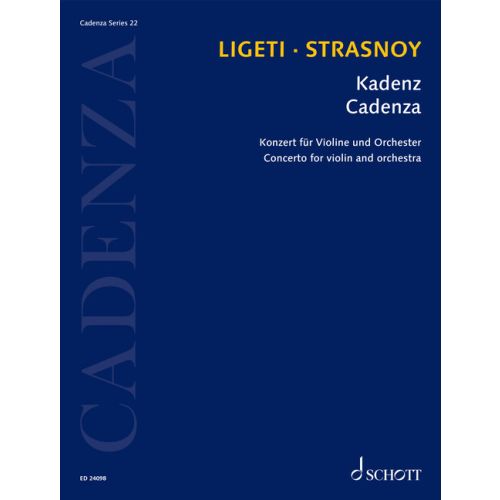
Cadenza
Product Details
Description
A highlight for soloists: Oscar Strasnoy’s cadenza for Ligeti’s Violin Concerto weaves together the work’s central motifs into a virtuosic journey and leads the solo part into a spectacular finale full of brilliance, musical freedom, and expressiveness.
'I attended the Paris premiere of Ligeti’s Violin Concerto at the Maison de la Radio together with my orchestration teacher Gérard Grisey, who said to me immediately after the piece ended: "This is a masterpiece; we still have a lot to learn." That reinforced my hunch that I had just heard the greatest concert piece of the second half of the 20th century. When Isabelle Faust asked me to “help” her find a cadenza for the work, I dropped everything and spent a week studying the work anew and devising a cadenza in the classical sense of the word: a rapid run-through of the entire work that incorporates a few highlights, framed by a final fireworks display of the instruments. Ligeti gives the performer room for virtuosic freedom at the decisive moment of the work—namely, right at the very end. This is a gesture of remarkable courage, which I hope I have done justice to.'
– Oscar Strasnoy
More Information
Prinzregententheater
Isabelle Faust, Violine · Conductor: Enrico Onofri · Münchener Kammerorchester
Prinzregententheater
Isabelle Faust, Violine · Conductor: Enrico Onofri · Münchener Kammerorchester
Prinzregententheater
Isabelle Faust, Violine · Conductor: Enrico Onofri · Münchener Kammerorchester
Technical Details
More from this series
Improvised and also composed solo cadenzas, normally occurring towards the end of a bravura aria or an instrumental concerto movement, have existed since the late 16th century. They provide the performer with an opportunity for self-presentation in the form of a free style of playing or singing, based on themes and motifs from previous sections of the movement. Solo cadenzas are for the most part introduced by a six-four chord held by the orchestra; the soloist then begins a protracting interpolation in free style, subsequently culminating on the dominant chord, usually with a trill. Whereas originally composers left solo cadenzas to be freely improvised, from the middle of the 19th century onwards they were frequently specifically written out. The increasing abuse of cadenzas as a mere display of free virtuosity, ignoring the style and impetus of the composition, played a substantial factor in this development. Thus Beethoven gives the soloist no opportunity whatsoever for free improvisation in his 5th piano concerto in which the cadenza becomes an integral, obligatory component of the complete work. In this unique series Schott Music presents cadenzas created for well-known instrumental concertos from the Classical and Romantic periods by major composers and soloists of our time.