english
  deutsch
  français
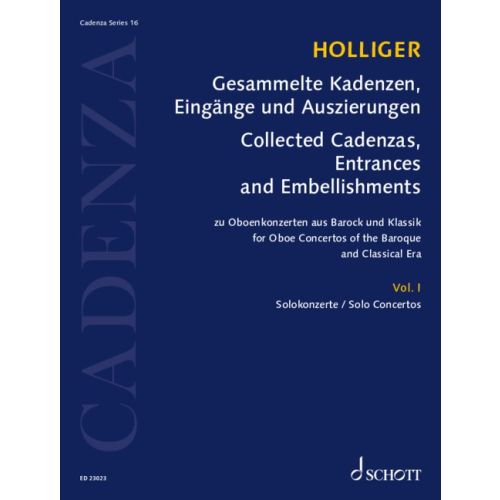
Collected Cadenzas, Embellishments and Arrangements
Product Details
Description
Cadenzas are usually improvised, but the sound engineers asked Heinz Holliger to write down the improvisations for the mix on his numerous recordings. The chronology of a rich soloist's life can thus be found in two volumes.
Content
Tomaso Albinoni (1671–1750): Concerto a cinque op. IX, No. 2 in d-Moll für Oboe und Streicher / in D minor for Oboe and Strings
Johann Sebastian Bach (1685–1750): Brandenburgisches Konzert Nr. 1 (BWV 1046) Trio
Carl Philipp Emanuel Bach (1714–1788): Konzert für Oboe, Streichorchester und Basso continuo (Wq. 164; H466) in B-Dur / in Bb major, Konzert für Oboe, Streicher Cnd Basso continuo (Wq. 165) in Es-Dur / in Eb major
Johann Christian Bach (1735–1782): Oboenkonzert Nr. 2 (C81) in F-Dur / in F major
Johann Gottlieb Graun (1701/02–1771): Konzert für Oboe, Streichorchester und Basso continuo (Wi 119) in c-Moll / in C minor
Franz Xaver Richter (1709–1789): Konzert für Oboe und Orchester in F-Dur / in F major
Carl Ditter von Dittersdorf (1739–1799): Concerto (Lane L. 41) in G-Dur / in G major, Concerto (Lane L. 42) in G-Dur / in G major
Antonio Rosetti (1750–1792): Konzert für Oboe und Orchester (Murray C. 30) in C-Dur / in C major
Josef Fiala (1748–1816): Konzert für Englischhorn und Orchester (Český hudební fond, Prag) in Es-Dur / in Eb major
Joseph Haydn (1732–1809) zugeschrieben / attributed to Joseph Haydn: Konzert für Oboe und Orchester (Hob. Vllg: C1) in C-Dur / in C major
Ludwig August Lebrun (1752–1790): Konzert Nr. 1 für Oboe und Orchester in d-Moll / in D minor, Konzert Nr. 2 für Oboe und Orchester in g-Moll / in G minor, Konzert Nr. 3 für Oboe und Orchester in C-Dur / in C major, Konzert Nr. 4 für Oboe und Orchester in B-Dur / in Bb major, Konzert Nr. 5 für Oboe und Orchester in C-Dur / in C major, Konzert Nr. 6 für Oboe und Orchester in F-Dur / in F major
Wolfgang Amadeus Mozart (1756–1791): Konzert für Flöte (Oboe) und Orchester (KV 313 (285c)) in F-Dur / in F major, Konzert für Oboe und Orchester (KV 314 (285d)) in C-Dur / in C major, Andante für Flöte und Orchester (KV 315) in C-Dur / in C major, Oboenquartett (KV 370) in F-Dur / in F major
More Information
Technical Details
More from this series
Improvised and also composed solo cadenzas, normally occurring towards the end of a bravura aria or an instrumental concerto movement, have existed since the late 16th century. They provide the performer with an opportunity for self-presentation in the form of a free style of playing or singing, based on themes and motifs from previous sections of the movement. Solo cadenzas are for the most part introduced by a six-four chord held by the orchestra; the soloist then begins a protracting interpolation in free style, subsequently culminating on the dominant chord, usually with a trill. Whereas originally composers left solo cadenzas to be freely improvised, from the middle of the 19th century onwards they were frequently specifically written out. The increasing abuse of cadenzas as a mere display of free virtuosity, ignoring the style and impetus of the composition, played a substantial factor in this development. Thus Beethoven gives the soloist no opportunity whatsoever for free improvisation in his 5th piano concerto in which the cadenza becomes an integral, obligatory component of the complete work. In this unique series Schott Music presents cadenzas created for well-known instrumental concertos from the Classical and Romantic periods by major composers and soloists of our time.