english
  deutsch
  français
Work of the Week – Lili Boulanger: Faust et Hélène
- By Christopher Peter
- 11 May 2026
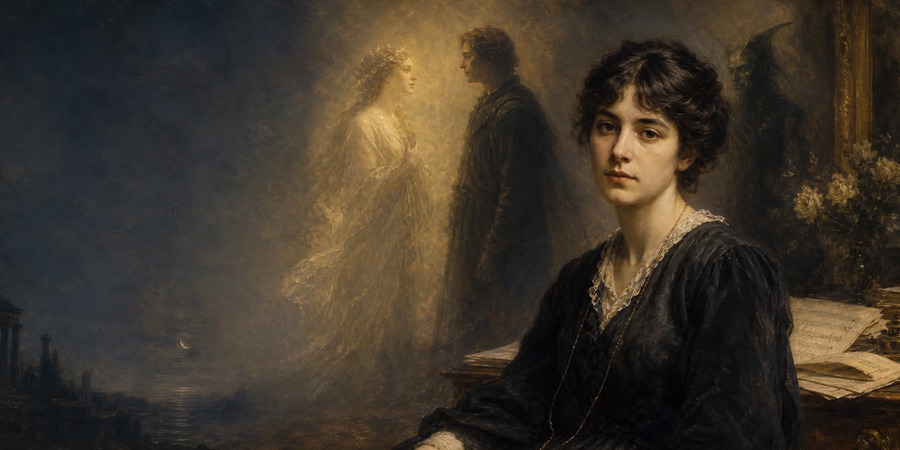
Sometimes a single work is enough to leave a permanent mark. Faust et Hélène is one of those pieces. Composed in 1913, it earned nineteen‑year‑old Lili Boulanger the Prix de Rome – making her the first woman ever to win it. A breakthrough moment. And yet, the cantata itself is far more than a prize‑winning statement.
Based on a libretto by Eugène Adenis after Goethe’s Faust Part II, the work focuses on the fatal encounter between Faust, Méphistophélès and Hélène of Troy. Faust yearns for the ultimate moment of beauty and is willing to trade his soul for it. Méphistophélès obliges. But Hélène resists. She remembers the countless deaths caused in her name. Desire flares – and collapses.
Boulanger’s music tells this story with remarkable intensity. Richly late‑Romantic yet strikingly concise, it moves between Wagnerian weight and impressionistic transparency, always driven by dramatic urgency. Nothing feels ornamental. Every gesture matters.
Written in 1913 and heard anew today: Faust et Hélène by Lili Boulanger
Originally scored for a large orchestra, the work has been re‑imagined by Eberhard Kloke in a new version for small orchestra (2023). His adaptation sharpens the dramatic focus and enhances textual clarity without diluting Boulanger’s expressive power.
The new version receives its staged premiere on 15 May 2026 at the German National Theatre Weimar, conducted by Daniel Carter and staged by Valentin Schwarz. Set and costume design are by Andrea Cozzi and Otto Krause. The soloists are Sayaka Shigeshima (Hélène), Sangmin Jeon (Faust) and Ilya Silchuk (Méphistophélès), joined by the Staatskapelle Weimar.
More than a historical rediscovery, Faust et Hélène speaks directly to our time – about longing, power and the cost of desire. And about a composer whose voice still resonates with startling clarity.
Learn more:
Illustration created using artificial intelligence