 français
  deutsch
  english
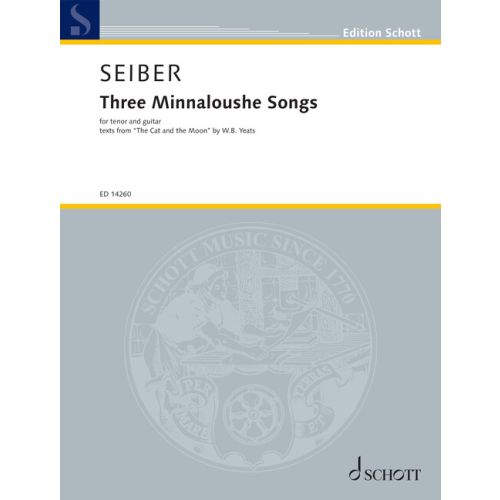
Three Minnaloushe Songs
Détails du produit
Description
In 2020, following the death of guitarist Julian Bream, his two adjoining cottages were cleared in preparation for sale. Among the items collected were his last guitar and lute, diaries, passports, photographs, platinum discs, and awards, some of which are now preserved at Trinity Laban. Later that same year, Jan Burnett, administrator of the Julian Bream Trust, and guitarist John Mills examined Bream’s partly converted garage studio. Inside an old cabinet, opened from the back, they found manuscripts together with photocopies of other scores.
Much later, in January 2025, while sorting through some of Bream’s collection, Mills identified a large, yellowed manuscript with faded ink. It proved to be a work by Mátyás Seiber (1905–1960), titled Minnaloushe Songs. The piece was not listed in any of the composer’s work lists and, prior to this discovery, there was no knowledge of its existence. The date of composition remains unknown at time of publication.
In a letter from W. B. Yeats to Belgian writer, Maurice Maeterlinck, dated 11 May 1917, the name “Minoulooshe” refers to Maeterlinck’s black Persian cat. Yeats recounts a moment from the previous summer in Calvados, Normandy when the cat, having walked behind them for a mile, was distracted by a fluttering wing in a bramble-bush and refused to come when called. Yeats remarks that the interruption cut short a conversation, the course of which he later explored in Per Amica Silentia Lunae. He would use the name “Minnaloushe” (with an altered spelling) again in his poem The Cat and the Moon.
Contenu
II Allegretto danzato (Minnaloushe runs in the grass)
III Moderato (Minnaloushe creeps through the grass)