 français
  deutsch
  english

Erich Wolfgang Korngold
À venir
À propos de Erich Wolfgang Korngold
Music is music whether composed for the stage, the conductor’s desk or for the cinema. The form can change and the method of notation can be different, but the composer cannot make any compromises in what he considers to be his musical convictions. (Erich Wolfgang Korngold)
Life and Artistic Development – From Child Prodigy to Celebrated Opera and Hollywood Composer
Erich Wolfgang Korngold was born on 29 May 1897 in Bruenn, Moravia, in the Austro-Hungarian Empire (today Brno, Czech Republic). This musical prodigy was the second son of Julius Korngold, prominent music critic of the Neue Freie Presse. Richard Strauss and Giacomo Puccini were two of the admirers of the musically precocious child’s compositional ability. Encouraged by his father, Korngold received his first music theory lessons at the age of six. When only nine, he performed his fairy tale cantata “Gold” for Gustav Mahler who immediately recommended Alexander von Zemlinsky as a teacher. In 1910, the ballet-pantomime Der Schneemann received its premiere in the Vienna Court Opera under the baton of Franz Schalk. The work was discussed in the cultural pages of the newspapers and certain critics doubted the authorship of the young composer. In 1916, public acclaim was again achieved with the premiere of the one-act operas Violanta and Der Ring des Polykrates under the direction of Bruno Walter. At the age of 20, Korngold performed his military service as a recruit in the military band of an infantry regiment. Three years later, the triumphal success of his opera Die tote Stadt began on a variety of European stages. With his fourth opera Das Wunder der Heliane (1927), Korngold was caught in the crossfire of a cultural dispute, partially initiated by his father, which had been sparked off by Krenek’s topical opera "Johnny spielt auf”. The cooperation with Max Reinhardt began in 1929 with the adaptation of Johann Strauss’s “Fledermaus”. In 1934, the director invited Korngold to Hollywood for a production of "A Midsummer Night's Dream". For the next four years, the composer divided his time between Vienna and Hollywood, ultimately settling in Hollywood in 1938, following the annexation of Austria by Nazi Germany. In Hollywood he became one of the most sought after film music composers in the USA. In the post-war years, the composer was unsuccessful in his attempts to re-establish himself on European cultural stages. Korngold died in Hollywood on 29 November 1957.
Music Theatre Works
Korngold’s music theatre works made him the most popularly performed German-speaking opera composer between 1910 and the 1930s alongside Richard Strauss. The opera Die tote Stadt (1916-1919) today continues to be included in the regular music theatre repertoire. The libretto based on Rodenbach’s novel “Bruges-la-morte” was written by Korngold himself in cooperation with his father under the pseudonym Paul Schott. Korngold’s music for the Symbolist, morbid text developed on the back of Late Romantic tonal worlds to form an independent expressive language tracing the psychology of the plot in great detail. Wunder der Heliane (1923-1926) which was considered by the composer as his most significant work marks a turning point in Korngold’s oeuvre. The monumental orchestral forces and the demands on the singers reach the limits of what is performable.
Orchestral Works and Symphonic Style
The violin concerto (Concerto in D major 1937-1939/1945), the cello concerto (Concerto in C, 1946) and the Symphony in F# for large orchestra (1947-1952) guarantee that Korngold’s works have their place on the concert stage. These three compositions are all late works and connect the expertise of the classical composer with his experiences within the realms of film music. In his concert works, Korngold drew partly on the best thematic material from his film scores, in the creation of his significant post-war compositions. The solo parts are virtuoso, the orchestral writing displays skill in the changes of tonal colouring and the emotionally dense music is characterised by a noble yet yearning melos. Particularly in the symphony, ambitious rhythms are paired with a rugged chromaticism which overflows into atonality.
Second Career as a Film Composer
During his second career as film music composer for the Warner Brothers Studios, the composer was able to bring the genre of symphonic film music to perfection. Korngold was one of the most influential co-founders of the “sound of Hollywood” with his classics such as The Adventures of Robin Hood (1938), The Sea Hawk (1940) and The Sea Wolf (1941). Korngold’s film music received four Oscar nominations. The composer was awarded the prize for the "Best Original Score" 1936 (Anthony Adverse) and 1938 (The Adventures of Robin Hood). Since 1995, the Erich Wolfgang Korngold Prize has been awarded by the foundation Deutsche Kinemathek for the lifework of an outstanding film music composer.
Liste d'œuvres
Chronologie
Produits
-
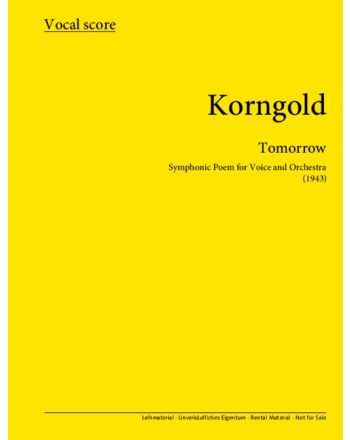 Symphonic Poem for Voice and OrchestraCompositeur: Erich Wolfgang KorngoldMedia Type: Matériel en location / d'exécutionEdition: Matériel d'exécutionLangue: AnglaisMatériel en location / d'exécutionMatériel en location / d'exécution
 -
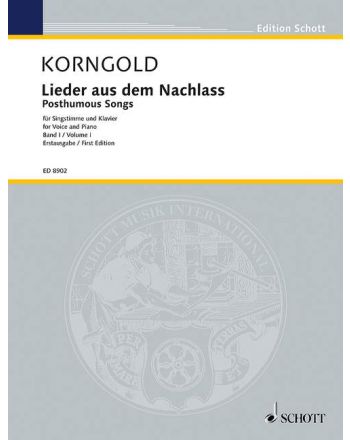 Compositeur: Erich Wolfgang KorngoldMedia Type: Partition électronique en PDFInstrumentation: medium voice and pianoLangue: AllemandNuméro du produit: ED 8902 Q7392Partition PDFPartition PDFEn stock2,99 €TTC
 -
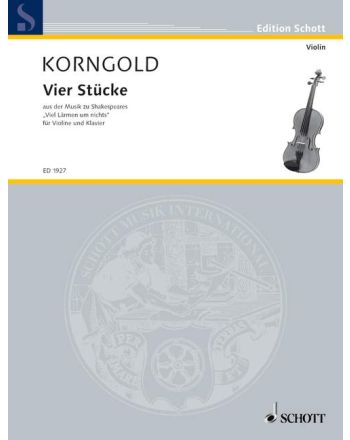 aus der Musik zu Shakespeares "Viel Lärmen um nichts"Compositeur: Erich Wolfgang KorngoldSérie: Edition Schott
Instrumentation: violon et pianoNuméro du produit: ED 1927Type de produitEn stockPrix à partir de 13,99 €TTC -
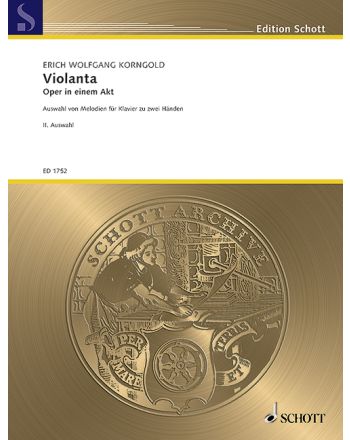 Book 2 | Auswahl II von Melodien für Klavier zu zwei HändenCompositeur: Erich Wolfgang KorngoldArrangeur: Ferdinand RebaySérie: Schott Archive, Numéro 2
Instrumentation: pianoNuméro du produit: ED 1752Type de produitEn stockPrix à partir de 16,99 €TTC -
 Book 1 | Auswahl I von Melodien für Klavier zu zwei HändenCompositeur: Erich Wolfgang KorngoldArrangeur: Ferdinand RebaySérie: Schott Archive, Numéro 1
Instrumentation: pianoNuméro du produit: ED 1751Type de produitEn stockPrix à partir de 16,99 €TTC -
 Vorspiel und KarnevalsmusikCompositeur: Erich Wolfgang KorngoldMedia Type: Matériel en location / d'exécutionEdition: Matériel d'exécutionMatériel en location / d'exécutionMatériel en location / d'exécution
 -
 Opera in one actCompositeur: Erich Wolfgang KorngoldMedia Type: Matériel en location / d'exécutionEdition: Matériel d'exécutionLangue: AllemandMatériel en location / d'exécutionMatériel en location / d'exécution
 -
 Compositeur: Erich Wolfgang KorngoldMedia Type: Partition électronique en PDFInstrumentation: medium voice and pianoLangue: AllemandNuméro du produit: ED 8902 Q7393Partition PDFPartition PDFEn stock2,99 €TTC
 -
 Compositeur: Erich Wolfgang KorngoldMedia Type: Partition électronique en PDFInstrumentation: medium voice and pianoLangue: AllemandNuméro du produit: ED 8902 Q7394Partition PDFPartition PDFEn stock2,99 €TTC
 -
 Three Piano PiecesCompositeur: Erich Wolfgang KorngoldMedia Type: PartitionInstrumentation: pianoNuméro du produit: ED 9125Format papierFormat papierEn stock14,50 €TTC, hors expédition
 -
 Compositeur: Erich Wolfgang KorngoldMedia Type: Partition électronique en PDFInstrumentation: medium voice and pianoLangue: AllemandNuméro du produit: ED 8902 Q7395Partition PDFPartition PDFEn stock2,99 €TTC