english
  deutsch
  français
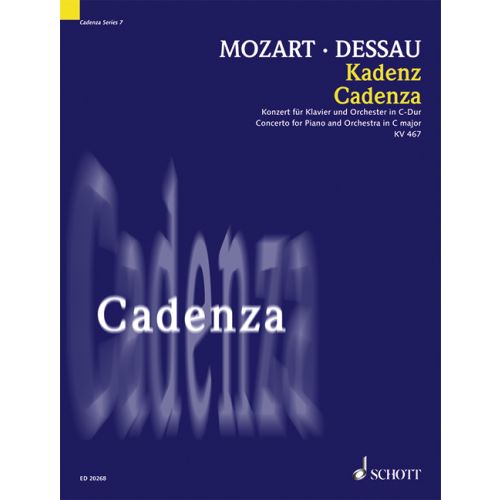
Cadenza
Product Details
Description
In our latest volume, we publish for the first time the cadenza written by Paul Dessau in 1947 on Mozart's Piano Concerto K 467. One may only speculate for which occasion it was composed by Dessau. Before returning to Germany from the USA in 1948, he had written numerous little piano pieces, most of them for piano lessons. In addition, he had rewritten his early piano sonata completely. In this context, he also noted down the names of pianists such as Vladimir Horowitz, Bruno Eisner and Leon Fleisher with whom he was in touch, hoping for the performance of the sonata. Perhaps the cadenza too was created in this hope. We do not know if it was ever performed. But now, all pianists are given the chance to play it!
More Information
Technical Details
Attachments
More from this series
Improvised and also composed solo cadenzas, normally occurring towards the end of a bravura aria or an instrumental concerto movement, have existed since the late 16th century. They provide the performer with an opportunity for self-presentation in the form of a free style of playing or singing, based on themes and motifs from previous sections of the movement. Solo cadenzas are for the most part introduced by a six-four chord held by the orchestra; the soloist then begins a protracting interpolation in free style, subsequently culminating on the dominant chord, usually with a trill. Whereas originally composers left solo cadenzas to be freely improvised, from the middle of the 19th century onwards they were frequently specifically written out. The increasing abuse of cadenzas as a mere display of free virtuosity, ignoring the style and impetus of the composition, played a substantial factor in this development. Thus Beethoven gives the soloist no opportunity whatsoever for free improvisation in his 5th piano concerto in which the cadenza becomes an integral, obligatory component of the complete work. In this unique series Schott Music presents cadenzas created for well-known instrumental concertos from the Classical and Romantic periods by major composers and soloists of our time.