 français
  deutsch
  english
Sonate
Détails du produit
Description
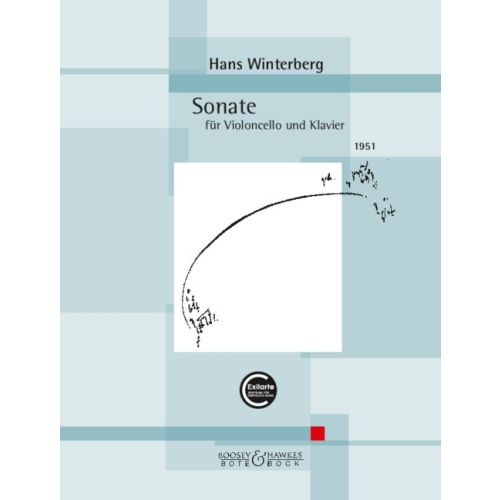
Hans Winterberg, born in Prague in 1901, lived through almost the entire period of the 20th century and was influenced as a composer by its most important artistic innovations. Already a brilliant pianist as an adolescent, he studied with Alois Hába and Alexander von Zemlinsky in Prague. Both his life and his music reflect the Austrian-Czech-Jewish cultural symbiosis; he saw himself as a bridge builder between Western and Eastern, i.e. Slavic, cultures. Owing to his Jewish ancestry, he was deported to the Terezin concentration camp after the annexation of Czechoslovakia by Nazi Germany. He was the only Jewish representative of the Czech musical avant-garde of the 1920s and 1930s to survive the Shoah and, in 1947, followed his non-Jewish wife and their daughter to the FRG in the course of the expulsion of the German-speaking population from Czechoslovakia. Winterberg's fascinating oeuvre, which was kept under lock and key in a German music archive for years after his death, is now being made accessible in first editions due to a cooperation between the Exilarte Center for Banned Music at the University of Music in Vienna and Boosey & Hawkes. The first printed edition is Winterberg's Cello Sonata, composed in 1951, in which all the characteristics of his unmistakable personal style come to the fore: dance-like energy, polyrhythm, intimate yet unsentimental melos, subtle handling of folkloristic material, and an unerring sense of form and balance. This work is of medium technical and great interpretative difficulty.
Plus d'infos
Détails techniques
Preview/Media Contents
Turning Points - Episode 2: Hans Winterberg
Turning Points - Episode 2: Hans Winterberg
Turning Points - Episode 2: Hans Winterberg
Plus de cette série
Hans Winterberg, 1901 als Spross einer seit Jahrhunderten in Prag ansässigen jüdischen Familie geboren, studierte bei Alexander von Zemlinsky und Alois Hába. Bis zur Annexion der Tschechoslowakischen Republik durch Nazideutschland 1939 wirkte er als Dirigent, Pianist und Komponist. Anders als seine Freunde und Kollegen Viktor Ullmann, Hans Krása und Gideon Klein überlebte er die Shoah durch eine Reihe von Wundern. 1945 siedelte er nach München über, wo er eine vielversprechende zweite Karriere begann. Als Vertreter einer gemäßigten Avantgarde sah er sich seit den späten 1960er Jahren mehr und mehr ins Abseits gedrängt. Nach seinem Tod 1991 geriet sein künstlerischer Nachlass in einem deutschen Musikarchiv unter Verschluss und, da zu seinen Lebzeiten kein Werk veröffentlicht worden war, in Vergessenheit. Boosey & Hawkes bringt seit 2023 Winterbergs Kammermusik in einem außergewöhnlichen Editionsprojekt als Erstausgaben heraus in Kooperation mit dem Exilarte Forschungszentrum der Universität für Musik und darstellende Kunst Wien. Sie offenbaren Musik von einzigartigem Reiz, in der Einflüsse Janáčeks, der Zweiten Wiener Schule und des französischen Impressionismus zu einem originellen und aufregenden Personalstil amalgamiert sind.