 français
  deutsch
  english
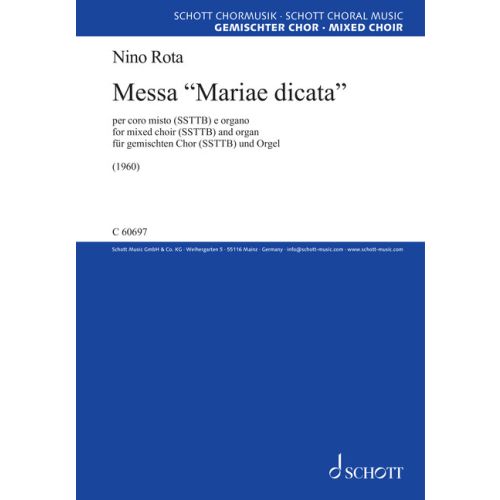
Détails du produit
Description
Nearly thirty works – including motets, masses, cantatas, and other sacred compositions – attest to the central role of religiously inspired music in Nino Rota’s (1911–1979) vocal, choral, and symphonic output. Of particular interest, owing to their close connection with the liturgical sphere, is the series of three masses he composed in rapid succession between 1960 and 1962, the first of which is the Messa per coro e organo “Mariae dicata”.
The Mass is structured according to the five fixed sections of the Ordinarium Missae (Kyrie, Gloria, Credo, Sanctus, Agnus Dei) and largely follows the traditional formal models associated with each movement. The vocal writing is predominantly homophonic, with occasional contrapuntal passages and a brief fugato in the Sanctus. Despite this economy of means, several distinctive features of Rota’s style stand out, such as the chromatic motifs that accompany the Gloria and the Credo. The organ primarily provides harmonic support, except in the passage preceding the intonation of the Benedictus, where reprises instrumentally the vocal incipit of the Gloria.
Contenu
Kyrie
Gloria
Credo
Sanctus
Agnus Dei
Appendice / Appendix / Anhang:
Agnus Dei (fino alternativo / alternate ending / alternatives Ende)
Credo (versione alternative / alternate version / alternative Fassung)