 français
  deutsch
  english
Lieferzeit
2-3 Tage
Christopher Cerrone (Compositeur) | Christopher Cerrone (Librettiste) | Italo Calvino (Auteur du texte original)
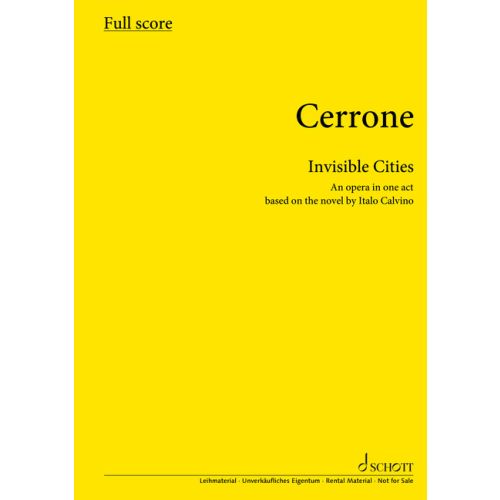
Invisible Cities
An opera in one act
based on the novel by Italo Calvino
ensemble de chambre et électroacoustique

Détails du produit
Orchestral Cast
1(afl).0.1(bcl).0-1.0.1.0-1perc(vib, glsp, crot, 1 chime, 2 sus cym, 2 almgl(G4, C5), tam-t, bell, sm s.d, lg s.d, wdbl, lg b.d, kick drum)-2pno-str(vn.va.vc)
Contenu
The music of Invisible Cities is the result of my first collision with Calvino’s extraordinary novel. For years I had been unable to bridge categories of music, thinking that a work could be either lyrical or conceptually rigorous, but not both. Calvino’s novel, however, is both a tightly structured mathematical work, yet also opens with the gorgeous line:
“In the lives of emperors there is a moment which follows pride in the boundless extension of the territories we have conquered, and the melancholy and relief of knowing we shall soon give up any thought of knowing and understanding them.”
After reading that sentence—so pregnant with meaning, lyricism, mood—I immediately began composing. I imagined the sound of a unearthly resonant and gong-like prepared piano, the ringing of bells, and wind players gently blowing air through their instruments. All of this would support a lyrical and deep voiced Kublai Khan who is slow moving and sings with gravitas. I imagined there would be two women, two high sopranos, who always sing together in harmony: they would be the musical personification of the cities that pervade the novel. And of course, our Italian explorer would be a tenor, light and quick moving, melismatic, and deft.
As with Calvino, there are many formally derived components to my opera. The orchestra is split into two (left and right) halves which alternate melodies to create the whole. The left part is associated Marco Polo, the right is associated with Kublai Khan. And the opera is structured as formally as the novel, always alternating Polo and the Khan’s conversations with Polo’s stories of le città.
To borrow a term from of one of Calvino’s favorite writers, Jorge Luis Borges, Invisible Cities is a garden of forking paths. As the work progresses, you might find yourself wandering back to the same place in Union Station again and again only to find new things happening each time. In the same way, the same few musical ideas of Invisible Cities are revisited again and again, just from vastly different perspectives. As we grow and evolve, the same objects in our lives can acquire such different meanings. That above else governs what Invisible Cities is about: how our memories change as we get older, how our map of the world gets larger, and how our past is always being changed by our ever-shifting present.
- Christopher Cerrone
Programmation des personnes
Kublai Khan · lyric baritone - Marco Polo · lyric tenor - Woman 1 · high lyric soprano - Woman 2 · full lyric soprano or lyric mezzo - Ensemble · SATB
Plus d'infos
Titre:
Invisible Cities
An opera in one act
based on the novel by Italo Calvino
Langue:
Anglais
Edition:
Matériel d'exécution
Niveau de difficulté:
avancé
Maison d'édition:
Schott Music
Year of composition:
2008 - 2011
Durée:
63 ′0 ′′
Première:
19 octobre 2013 · Los Angeles, CA (USA)
Union Station
Musikalische Leitung: Marc Lowenstein · The Industry
Union Station
Musikalische Leitung: Marc Lowenstein · The Industry
Travaux commandés :
Commissioned by Stephen A. Block and Raulee Marcus for The Industry, Los Angeles
Mots clés:
Détails techniques
Type de support:
Matériel en location / d'exécution
Numéro du produit:
LSMC 50694
Droits de livraison:
Pour le monde entier
Fabricant:
représentations
Invisible Cities
Chef d'orchestre: Marc Lowenstein
Orchestre: The Industry
19 octobre 2013 |
Los Angeles, CA (États-Unis d'Amérique) , Union Station — Première mondiale
Commentaires
Seul(e)s les utilisateurs/-trices enregistré(e)s peuvent écrire des commentaires. S’il vous plaît, connectez-vous ou créez un compte.