 français
  deutsch
  english
Lieferzeit
2-3 Tage
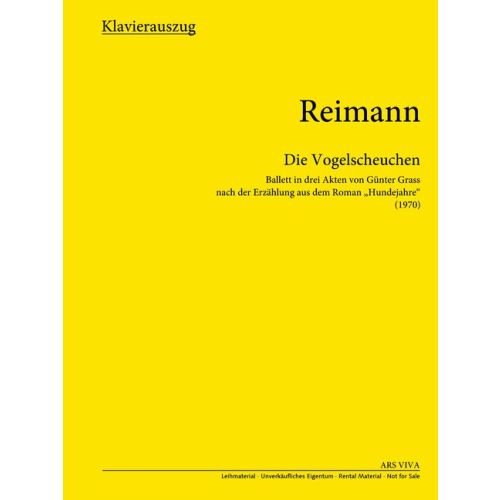
Die Vogelscheuchen
Ballett in drei Akten von Günter Grass
nach der Erzählung aus dem Roman "Hundejahre"

Détails du produit
Description
The gardener‘s primary concern is to maintain law and order in his garden to which birds keep gaining entry. Yet despite his concerns his daughter keeps encouraging them into the garden. Feeling helpless, the father begins to construct a scarecrow; once it‘s fi nished, the world of the scarecrows comes into being. The world of the scarecrows is populated by strange scarecrows; the abbess introduces them to the gardeners daughter who is attempting to learn the language of the scarecrows before being forced to marry the prefect of the scarecrows who has fallen in love with her. During the increasingly confused wedding procession she manages to escape. The gardener refuses his daughter entry into his house. The scarecrows appear to carry her back to her realm but it‘s too late, the birds are involving themselves in the proceedings and attack the gardener. Only one solution remains: the gardener himself turns into a scarecrow to keep the birds out of the garden.
"… this is material for a ballet. And Reimann has realized the sound for it. An amazing sound, lifted from an orchestra with large divisi strings, soloistically and chordally interlocked winds and countless percus- sion instruments played by nine players. Two characters dominate the sonorous scene: the whispering and murmuring of the strings playing glissandos in harmony as a symbol of sounds of a fl ock of birds; a pandemonium of rattling, jingling and hissing noises as an image of the lifeless underworld. From these two musical visions, Reimann derives the sonorous forms of the three acts and 25 scenes with a phenomenal hearing accuracy. Sound and rhythm shape into forms; thick tone clusters take shape. Melody in the traditional sense is omitted; but the colours, tone clusters, maintained complexes form a kind of underlying melody. It serves, almost automatically, as an orientation for the dance-like gesture to the mimed form. It is an entirely personal other-worldly music far away from modern conformism which only looks for a connection to examples in the ‘Suite’ of the underworld scene by means of quotations and collages of Bach, Bonporti and Schubert." (H. H. Stuckenschmidt, FAZ, 13 October 1970)
"… this is material for a ballet. And Reimann has realized the sound for it. An amazing sound, lifted from an orchestra with large divisi strings, soloistically and chordally interlocked winds and countless percus- sion instruments played by nine players. Two characters dominate the sonorous scene: the whispering and murmuring of the strings playing glissandos in harmony as a symbol of sounds of a fl ock of birds; a pandemonium of rattling, jingling and hissing noises as an image of the lifeless underworld. From these two musical visions, Reimann derives the sonorous forms of the three acts and 25 scenes with a phenomenal hearing accuracy. Sound and rhythm shape into forms; thick tone clusters take shape. Melody in the traditional sense is omitted; but the colours, tone clusters, maintained complexes form a kind of underlying melody. It serves, almost automatically, as an orientation for the dance-like gesture to the mimed form. It is an entirely personal other-worldly music far away from modern conformism which only looks for a connection to examples in the ‘Suite’ of the underworld scene by means of quotations and collages of Bach, Bonporti and Schubert." (H. H. Stuckenschmidt, FAZ, 13 October 1970)
Orchestral Cast
Picc. · 1 · Altfl. · 1 · Engl. Hr · Es-Klar. · 1 · Bassklar. · 2 · Kfg. - 4 · 4 · 3 · 1 - P. S. (Sopran-Glsp. · Sopran-Metallophon · Kastenglsp. · Sopran-Xyl. · 4 hg. Beck. · 2 ant. Zimb. · 2 kl. Gongs · 2 Tamt. · 5 Tomt. · Rasseltr. · Rührtr. · 3 Schlitztr. · kl. Tr. · Mil. Tr. · gr. Tr. · Röhrengl. · Cow Bells · Schiffsgl. · 4 Bong. · 4 Holzbl. · 5 Tempelbl. · Sistrum · Bambusraspel · gr. Hammer · Clav. · hg. Bambusrohre · Metallrassel · Brummtopf · Flex. · 2 Mar. · Kettenrassel · Tamb. · Schellen · hg. Metallröhren · Metallfolie · Kast. · Ratsche · Sandbl. · Peitsche · Windmasch. · Rute · Holzfass · Guiro · Bin Sasara · Sirene [t.] · Angklung · Lotosfl. · Galtonpfeife [od. andere Pfeife] · Waldteufel) (6 Spieler) - Str. (12 · 12 · 10 · 8 · 6)
Programmation des personnes
Der Gärtner - Seine Tochter - Vogelscheuchen (Der Präfekt, Die Äbtissin, Grenadier, Hallelujascheuchen) - Solovögel - Vögel und Vogelscheuchen (Ritter ohne Kopf, Nonnen mit Fallsucht, Grenadiere, Uniformierte)
Plus d'infos
Titre:
Die Vogelscheuchen
Ballett in drei Akten von Günter Grass
nach der Erzählung aus dem Roman "Hundejahre"
Edition:
Matériel d'exécution
Maison d'édition:
Ars Viva Verlag
Year of composition:
1970
Durée:
60 ′0 ′′
Première:
7 octobre 1970 · Berlin (D)
Deutsche Oper
Berliner Festwochen 1970
Musikalische Leitung: Ashley Lawrence
Inszenierung: Marcel Luipart · Kostüme: Liselotte Erler · Bühnenbild: Erich Kondrak · Choreographie: Marcel Luipart
(scenic) (scenic performance)
Deutsche Oper
Berliner Festwochen 1970
Musikalische Leitung: Ashley Lawrence
Inszenierung: Marcel Luipart · Kostüme: Liselotte Erler · Bühnenbild: Erich Kondrak · Choreographie: Marcel Luipart
(scenic) (scenic performance)
Travaux commandés :
Auftragswerk der Deutschen Oper Berlin / Commissioned by Deutsche Oper Berlin
Détails techniques
Type de support:
Matériel en location / d'exécution
Numéro du produit:
LAVV 3345-01
Fabricant:
représentations
Die Vogelscheuchen
Chef d'orchestre: Hans Gierster
5 novembre 1971 |
Nürnberg (Allemagne) , Opernhaus — Première soirée
Die Vogelscheuchen
Berliner Festwochen 1970
Chef d'orchestre: Ashley Lawrence
7 octobre 1970 |
Berlin (Allemagne) , Deutsche Oper — Première mondiale (szenische Aufführung)
Commentaires
Seul(e)s les utilisateurs/-trices enregistré(e)s peuvent écrire des commentaires. S’il vous plaît, connectez-vous ou créez un compte.