
 english
  deutsch
  français

Wilhelm Killmayer
About Wilhelm Killmayer
A single note is very precious for me - like a crystal or a flower. (Wilhelm Killmayer)
Wilhelm Killmayer was born in Munich on 21 August 1927. He spent his early childhood in Mitterndorf near Dachau, but subsequently moved to Munich with his family on the death of his father. Killmayer received regular piano tuition from the age of six. After passing his Abitur, he studied conducting and composition at Hermann Wolfgang von Waltershausen’s Musikseminar in Munich (1945-1951). Alongside courses in musicology given by Rudolf von Ficker and Walter Riezler, Killmayer simultaneously undertook private studies with Carl Orff (1951-1953) and subsequently entered his master class at the Staatliche Musikhochschule in Munich (1953/54). From 1955, Killmayer taught music theory and counterpoint at the Trappsches Konservatorium in Munich and was employed by the Bavarian State Opera as ballet conductor between 1961 and 1964. After two scholarship sojourns in Rome in the Villa Massimo (1958 and 1965/66), Killmayer became a freelance composer and settled in Frankfurt am Main in 1968. He was appointed as professor of composition at the Staatliche Hochschule für Musik in Munich in 1973. From becoming emeritus professor in 1992 to his death in 2017 in Starnberg, Killmayer divided his time between Munich and Lake Chiemsee.
As early as the post-war decades, the young composer had turned his back on the theoretical dogmas of serial music and developed his own personal style born primarily out of his study of 19th century musical traditions. Orchestral works such as Nachtgedanken (1973), the three Sinfonien (“Fogli”, 1968; “Ricordanze”, 1968/69 and “Menschen-Los”, 1972/73 rev. 1988) and the three Kammermusiken (The woods so wilde, 1970; Schumann in Endenich, 1972 and Kindertage, 1973) were created within the conflicting fields of ostinato repeats of individual motives and rhythms and a frequently radical reduction of compositional devices. In his stage works La Buffonata (1959/60) and Yolimba (new version 1970), both set to texts by Tankred Dorst, Killmayer enabled the stylistic mediums of parody and musical humour to permeate the realms of contemporary music.
The individual note and its melodic power lie at the core of Wilhelm Killmayer’s aesthetics. The voice is the most natural medium for melody and this concept was borne out by Killmayer in many of his vocal compositions. During the 1980s, he composed the three cycles of Hölderlin Lieder which exist in two versions with either piano or orchestral accompaniment, subsequently followed by the Eichendorff Lieder (1991), Trakl Lieder (1993 and 1996) and Härtling Lieder (1993). In 2006, Killmayer composed a setting of Heinrich Heine’s ballad Ali Bey, and a year later Eduard Mörike’s Der Feuerreiter.
In 1954, Killmayer was awarded the prize by the Music Foundation in Chicago for his Missa brevis. In 1957, he received the Kulturpreis from the City of Munich for Une leçon de français and in 1965 the Prix Italia. Killmayer was awarded a scholarship by the Cité des Arts in Paris and participated in the Rostrum of Composers, also in Paris, in 1974 with his Sinfonia 1 “Fogli”. In 1989, he received the Paul Hindemith Prize under the auspices of the Schleswig-Holstein Music Festival, in 1993 the Bayerische Maximiliansorden for Science and Art and in 2010 the chamber music prize presented by the Christoph und Stephan Kaske Foundation.
Killmayer has been a full member of the Bavarian Akademie der Schönen Künste (since 1972) and the Berlin Akademie der Künste (since 1980).
Worklist
Gallery



Chronology
Spends his childhood in Mitterndorf near Dachau until 1932, lives in Munich from 1932
Products
-
 Essay symphoniqueComposer: Wilhelm KillmayerMedia Type: Hire/performance materialEdition: Performance materialInstrumentation: orchestraHire/performance materialHire/performance material
 -
 Essay symphoniqueComposer: Wilhelm KillmayerMedia Type: Sheet musicEdition: Study scoreInstrumentation: orchestraProduct number: ED 7066Print editionPrint editionIn stock€24.00Incl. Tax, Excl. Shipping
 -
Composer: Wilhelm KillmayerEdition: Choral scoreSeries: Schott Chamber Choir
Instrumentation: mixed choir (SATB) with soloists (SATB)Product number: SKR 20029Product TypeIn stockAs low as €9.99Incl. Tax -
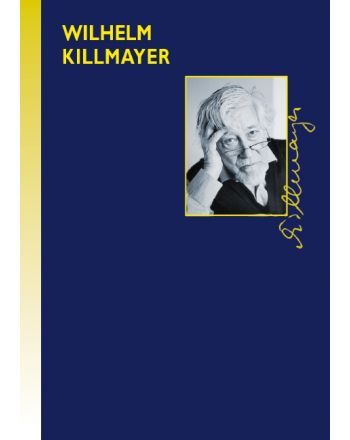 List of Published WorksPromotional materialPromotional materialIn stock€0.00Incl. Tax, Excl. Shipping
 -
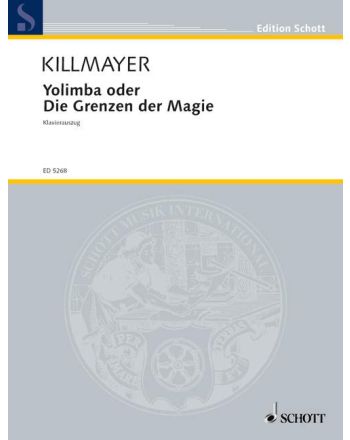 Musikalische Posse in einem Akt und vier LobgesängenComposer: Wilhelm KillmayerEdition: Piano reductionSeries: Edition Schott
Yolimba
Product number: ED 5268Product TypeIn stockAs low as €52.99Incl. Tax -
Musikalische Posse in einem Akt und vier LobgesängenComposer: Wilhelm KillmayerMedia Type: Hire/performance materialEdition: Performance materialLanguage: GermanHire/performance materialHire/performance material
-
 Walzer für OrchesterHire/performance materialHire/performance material


